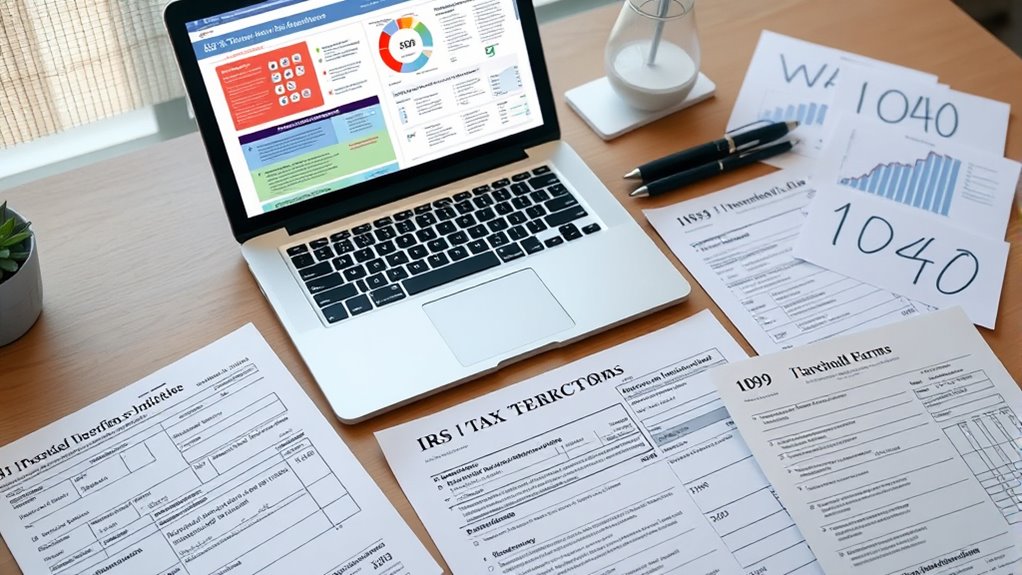
IRS tax forms are key to accurately reporting your income and taxes. The 1040 is your main form for filing individual taxes, while W-2 shows your employment wages and taxes withheld. W-4 helps your employer determine your withholding amount, and 1099 reports income from self-employment or freelance work. Understanding how each form functions ensures you’re compliant and organized. Keep exploring to get a clearer picture of what each form requires and how to handle them properly.
Key Takeaways
- IRS Form 1040 is the main individual income tax return, detailing total income, deductions, and credits.
- W-2 reports wages and taxes withheld from employment, issued by employers to employees.
- W-4 determines withholding amounts from your paycheck, guiding your employer on tax deductions.
- 1099 forms (e.g., 1099-MISC, 1099-NEC) report non-employee income over $600 from clients or companies.
- Understanding each form’s purpose ensures accurate reporting, timely filing, and compliance with IRS requirements.
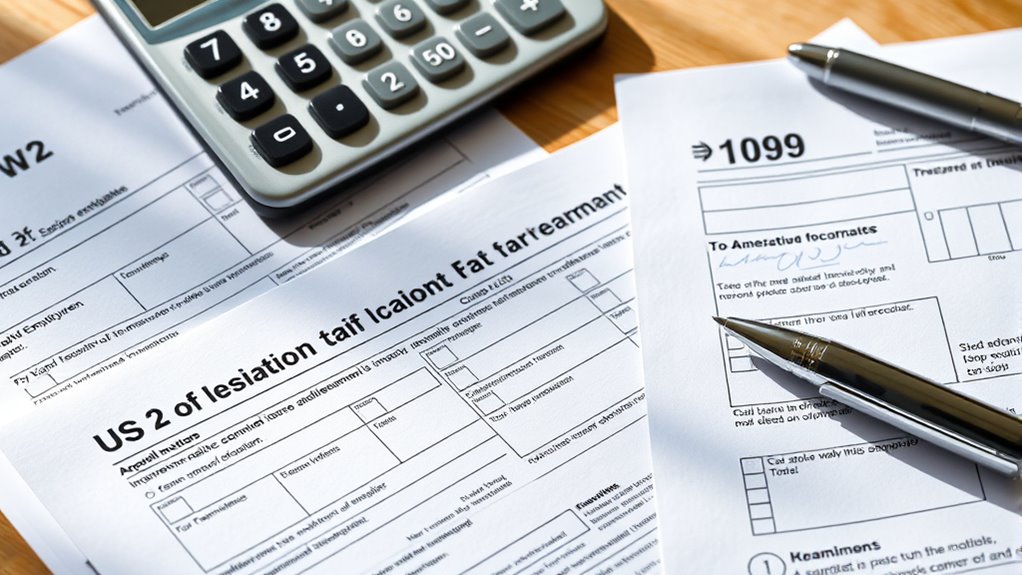
Understanding IRS tax forms can seem overwhelming, but understanding the basics makes the process much easier. When you’re preparing to file your taxes, knowing which forms you need and how to handle them can save you time and stress. One of the first things to keep in mind is the tax filing deadlines. Typically, individual tax returns are due by April 15 each year, but it’s essential to stay updated on any changes or extensions that may apply. Missing these deadlines can result in penalties and interest, so setting reminders and organizing your documents early helps guarantee you meet your obligations on time.
Knowing tax deadlines and staying organized ensures timely filing and reduces stress.
Filing your taxes involves submitting various forms depending on your income sources and financial situation. The W-2 form is necessary if you’re an employee. It reports your wages and the taxes withheld from your paycheck. When you receive your W-2, review it carefully for accuracy—check your name, Social Security number, and the reported income. If you notice discrepancies, contact your employer for corrections before filing. Including your W-2 with your tax return is straightforward, but be sure to do so before the deadline to avoid penalties. A useful tip for smooth submissions is to file electronically; e-filing reduces errors and provides confirmation of receipt. Remember, the IRS encourages electronic submissions because they process faster and help you get your refund sooner.
If you’re self-employed or work freelance, you’ll likely encounter the 1099 form. The 1099-MISC or 1099-NEC reports your non-employee income, and you should receive it if you earned more than $600 from a single source. When you receive a 1099, verify that the income listed matches your records. Unlike W-2 forms, which are typically sent directly by employers, 1099 forms come from clients or companies you worked for. Be proactive—keep copies of all your income statements and receipts to support your entries. When it’s time to file, include your 1099 income on Schedule C or other relevant forms. To streamline the process, gather all your 1099s early, double-check for accuracy, and consider using tax software or consulting a professional for complex situations. Additionally, being aware of specialty grocery store hours can help you plan your shopping trips efficiently while managing your tax-related tasks.
Understanding the purpose of each form and adhering to the tax filing deadlines is essential. Use form submission tips such as filing early, double-checking your entries, and opting for electronic filing to avoid errors and delays. Staying organized and proactive makes handling IRS tax forms less intimidating and helps guarantee you meet your obligations smoothly and on time.
Frequently Asked Questions
When Should I File My W-2 and W-4 Forms Each Year?
You should file your W-2 form by January 31 each year to report your income, and your employer must send it to you by this date. For your W-4, submit an updated form anytime your financial situation changes, but it’s best to do so prior to the start of the new tax year. Keep track of tax deadlines and guarantee timely form submission to avoid penalties and ensure accurate tax filings.
How Do I Correct Errors on a Submitted 1099 Form?
Suppose you submitted a 1099 and realize you made an error. You should file an amended 1099 using the IRS correction procedures within the correction deadline, which is generally by the end of the year. To do this, submit a corrected 1099 form with the “CORRECTED” box checked. Always follow the IRS guidelines to guarantee timely amendments and avoid penalties.
Are There Penalties for Late W-2 or 1099 Submissions?
Yes, there are penalties for late W-2 or 1099 submissions. The penalties overview shows that if you miss the filing deadlines, you could face fines based on how late you are and the size of your business. To avoid penalties, make sure you meet the IRS filing deadlines, typically January 31 for W-2s and 1099s. Prompt filing helps you stay compliant and avoid unnecessary penalties.
Can I File My Tax Forms Electronically or Only by Mail?
Filing your tax forms is like choosing a fast lane—you can do it electronically or by mail. Electronic filing offers quicker processing and instant confirmation, making it more convenient. Paper submission, while still accepted, takes longer to process and can be less secure. Most taxpayers prefer electronic filing for its speed and ease, but you can always opt for traditional paper submission if you prefer or if required.
What Are the Privacy Protections for My W-4 Withholding Information?
You can trust that your W-4 withholding information is protected by strict tax privacy and data security measures. The IRS uses secure systems to keep your personal details confidential, and access is limited to authorized personnel. Rest assured, your sensitive information is safeguarded against unauthorized access or breaches, ensuring your privacy remains intact. Always use official channels when submitting or updating your W-4 to maintain this protection.
Conclusion
Understanding IRS tax forms like 1040, W-2, W-4, and 1099 might seem intimidating, but mastering them is your secret weapon against tax season chaos. Think of these forms as your financial compass—guiding you through the complex maze of taxes with ease. With just a bit of knowledge, you’ll avoid mistakes that could feel like steering a jungle without a map. Stay informed, stay prepared, and conquer tax season like a pro!