
TL;DR

Get smart everyday buys delivered free — and shop member deals
- Fast, free delivery on millions of items
- Access to Prime Big Deal Days deals on October 6–7
- Prime Video, Amazon Music and more included
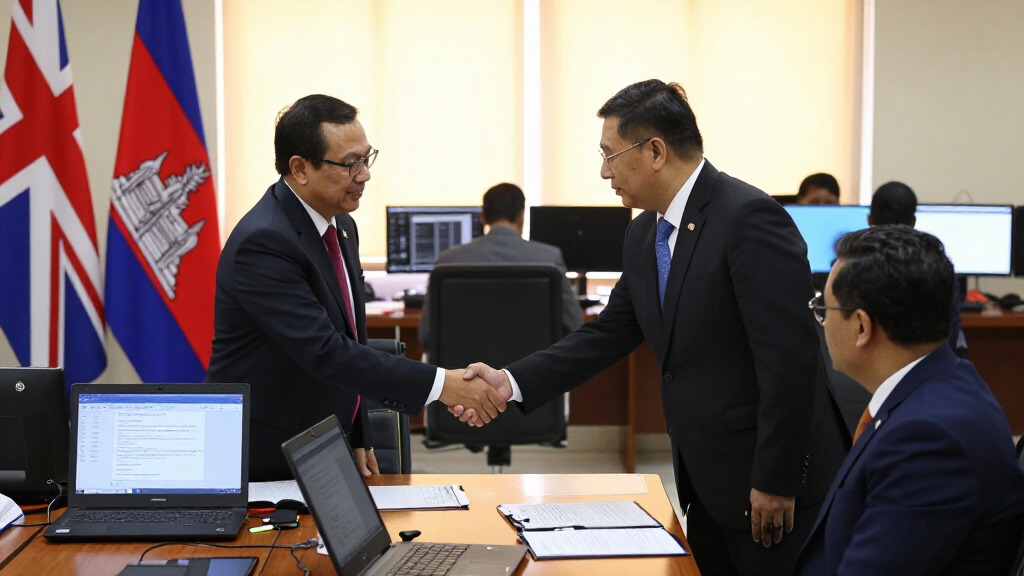
Search and coverage interest is spiking around a reported agreement between the UK and Cambodian governments on online scams. The metadata confirming the signing itself is the only verified signal — the trigger, terms, and signatories are unconfirmed. The interest fits a well-documented backdrop of scam compounds in Southeast Asia and rising fraud losses in the UK.
An agreement on online scams between the UK and Cambodian governments is generating a sharp spike in search and news coverage, according to trending-topic metadata. That metadata — a single market-feed line stating an agreement was signed — is the only verified information available at this stage. No official statement, joint communiqué, or named signatory has been independently confirmed, and the circumstances that triggered the coverage remain unclear.
What is confirmed at this point is narrow: a trending item labelled “Online scams agreement signed between UK and Cambodian governments” is circulating via market and RSS feeds, and public interest in the topic has risen measurably. The exact baseline for that rise is not provided by the source, so the volume of interest should be treated as a raw observation rather than a quantified surge.
Everything beyond the headline — who signed the agreement, when, where, and what it contains — is unconfirmed. It is not yet clear whether this is a formally negotiated bilateral treaty, a memorandum of understanding, a law-enforcement cooperation arrangement, or a looser political declaration. No UK government department, Cambodian ministry, or embassy statement quoted in reliable reporting has been verified for this article, and readers should treat specific claims about the deal’s contents as provisional until official confirmation appears.
The plausibility of such an agreement, however, is grounded in long-established facts. Cambodia has been widely documented — by the United Nations Human Rights Office, investigative journalists, and NGOs — as a centre of large-scale fraud compounds, particularly along its borders, where workers are frequently trafficked or coerced into running romance scams, investment fraud, and cryptocurrency schemes targeting victims worldwide, including in the UK. UK fraud statistics are also well documented: UK Finance, the banking industry body, has reported for years that hundreds of millions of pounds are lost to authorised and unauthorised fraud annually, with a substantial share of online scam operations traced to Southeast Asia.
Why a UK-Cambodia Scam Deal Would Matter
If an agreement of this kind has indeed been signed, it would matter for three reasons. First, the UK has one of the most fraud-exposed economies in the world relative to its size, according to repeated findings by UK regulatory and industry bodies, and a meaningful share of the scam messages, fake investment platforms, and romance fraud scripts aimed at UK victims originate from operations in Cambodia and neighbouring countries. Any formal cooperation channel could, in principle, speed up intelligence-sharing and the disruption of these networks.
Second, Cambodia’s government has faced sustained international pressure over the scam compounds. UN human rights officials have estimated that large numbers of people, many of them trafficking victims, have been held in these facilities. A bilateral agreement with a major Western government would signal — if confirmed — a step toward greater Cambodian cooperation on enforcement and victim protection, an area where NGOs have long criticised progress as slow and uneven.
Third, agreements of this type often set precedents. If the UK secures operational cooperation with Cambodia, other affected countries could follow, potentially expanding coordinated action against the transnational criminal networks behind online fraud.
The Scam-Compound Backdrop Behind the Headline
The reported agreement fits a well-documented regional crisis. Since around 2021, investigators, the UN, and journalists have exposed how compounds in Cambodia, Myanmar, and Laos house industrial-scale scam operations, often staffed by people deceived with fake job offers and forced to work under coercion. The UN Office on Drugs and Crime has described a criminal economy generating billions of dollars annually from these operations.
Victims span the globe. UK-based consumers have reported losses from romance scams, cryptocurrency investment fraud, and impersonation schemes of the kind documented as running from these compounds. Governments including the United States, China, and several Southeast Asian states have pursued repatriations of trafficked workers and, in some cases, joint enforcement actions — though Cambodian crackdowns have produced mixed results, with compounds frequently relocating or reconstituting after raids.
Any UK-Cambodia arrangement would sit within this history: a response to both the scale of fraud losses in the UK and the persistent difficulty of pursuing cross-border criminal networks operating from Cambodian territory.
Unverified Terms, Timing, and Signatories
The central uncertainty is the agreement itself. The only verified signal is trending metadata; no primary source — a UK government press release, a Cambodian government announcement, or an official readout — has been confirmed. It is not yet clear when the agreement was signed, which departments or ministers were involved, whether it is legally binding, or what specific obligations it creates.
Also unconfirmed: whether the deal includes provisions on extradition, asset recovery, victim repatriation, or joint investigations — the elements typically sought in anti-fraud cooperation. Whether the agreement addresses the trafficking dimension of the scam compounds, or only the fraud itself, is likewise unknown. Claims circulating on social media about the deal’s contents should be treated with caution until an official text or statement is published.
What to Watch for Official Confirmation
Confirmation, if it exists, would most likely come from the UK Home Office, Foreign Office, or the British Embassy in Phnom Penh, or from Cambodia’s interior or justice ministries. Readers should watch for an official readout or joint statement, which would establish the agreement’s date, signatories, and scope.
Subsequent indicators of substance would include any announced joint law-enforcement operations, changes in trafficking-victim repatriations involving UK nationals or UK-based victims, or follow-up statements from NGOs monitoring the compounds. Until then, the agreement’s practical impact on UK scam losses — which run to hundreds of millions of pounds annually according to industry figures — remains an open question.
Key Questions
Has the UK-Cambodia online scams agreement been officially confirmed?
Not in any form verified for this article. The only confirmed signal is trending coverage metadata stating that an agreement was signed. No official statement, text, or named signatory has been independently verified, so the agreement’s existence and details remain unconfirmed.
Why would the UK sign a scams agreement with Cambodia specifically?
Cambodia has been extensively documented by the UN, journalists, and NGOs as a hub of large-scale scam compounds, many staffed by trafficked workers, that run romance and investment fraud targeting victims worldwide, including in the UK. Fraud is one of the most common crimes affecting the UK, so cooperation with a source country has clear practical value — if such an agreement exists and is operational.
What could such an agreement typically cover?
Bilateral anti-fraud arrangements often include intelligence-sharing, joint investigations, extradition or legal cooperation, asset recovery, and victim support or repatriation. Whether any of these elements are in the reported agreement is unknown, since no text or official summary has been confirmed.
Are UK scam losses actually linked to Cambodia?
Industry and enforcement reporting has repeatedly linked online fraud affecting UK victims to operations in Southeast Asia, including compounds in Cambodia. The precise share of UK losses attributable to Cambodian operations is not established in publicly available verified figures.
How will I know when the details are confirmed?
Look for a press release or readout from the UK Home Office or Foreign Office, the British Embassy in Phnom Penh, or Cambodian government ministries. An official statement would establish the signing date, the parties involved, and the agreement’s terms — the benchmarks against which any further reporting should be checked.
Source: rss
Fall Picks
fall essentials
As an affiliate, we earn on qualifying purchases.