Fractional real estate investing platforms let people buy an interest in property without purchasing an entire building, but the right choice depends on what you need to learn before committing money. The Fractional Investor is my best overall pick for its broader portfolio focus, while Beyond the Savings Account stands out for beginners and Tokenized Real Estate Investing Guide for readers curious about digital ownership. The main tradeoffs are how much a guide covers about risk, liquidity, platform mechanics, and income strategy. These are books and guides, not platforms themselves, so they can help you compare services but cannot replace checking each platform’s current terms. Read on for the full breakdown and a guide to choosing what matters most.

Get smart everyday buys delivered free with Prime
- Fast, free delivery on millions of items
- Prime Video, Amazon Music and more included
- Member-only deals all year
Key Takeaways
- The Fractional Investor ranks first because its hard-asset and portfolio framing gives readers a wider starting point than guides centered only on rental income or tokenization.
- Beyond the Savings Account is the clearest beginner-oriented option in this lineup, pairing fractional property with tokenized real-world assets and a practical extra-cash framing.
- Fractional Real Estate foregrounds conservative wealth-building, making its risk-minded premise distinct from the more expansive portfolio approach of Fractional Wealth.
- Several guides focus on specific strategies—such as liquidity, tokenization, or rental income—so readers should match the topic to the decision they are trying to make rather than expect one book to cover every platform feature.
- These titles are educational resources, not investing platforms or current platform comparisons; availability, fees, liquidity rules, and investor eligibility need independent verification.




| fractional real estate investing platform | Format | ASIN | Primary topic |
|---|---|---|---|
| The Fractional Investor: How t | Book | B0HFG77DZV | Building a real estate and hard-asset portfolio |
| Fractional Real Estate: How to | Book | B0DP7V5GG9 | Fractional real estate investing |
| Beyond the Savings Account: A | Book | B0HJKVHCY3 | — |
| Owning Pieces of Property Powe | Book | B0FR1WYMRX | Fractional real estate ownership |
| The Ultimate Guide to Fraction | Book | B0DY5CH9KR | Fractional real estate investing |
| Fractional Wealth: How to Buil | Guide | — | — |
| Tokenized Real Estate Investin | Guide | — | — |
| Level Up in Fractional Real Es | Book | — | — |
More Details on Our Top Picks
The Fractional Investor: How to Build a Modern Real Estate and Hard Asset Portfolio Without Buying Physical Property
The Fractional Investor takes a wider portfolio view than Fractional Real Estate, pairing real estate with other hard assets and focusing on ways to invest without owning property directly. That makes it a fit for readers who want to compare fractional property with other asset categories, rather than concentrate only on shared real estate ownership. Its place in the Solopreneur’s Wealth Creation Series also gives it a defined series context. The tradeoff is that the description offers less detail on specific platform selection, liquidity, or risk controls than Owning Pieces of Property Power, which explicitly covers those topics. I’d choose this guide for a broad, non-physical-ownership framework, but readers seeking practical guidance on platform mechanics may prefer a more narrowly focused title.
Pros:- Addresses real estate and hard assets together, giving readers a broader portfolio frame.
- Focuses on investing without purchasing physical property.
- Belongs to a named wealth-creation series, which may suit readers following a sequence.
Cons:- The available description does not identify particular platforms or explain how their terms differ.
- No specific coverage of liquidity options or risk controls is provided.
- The broader hard-asset scope may offer less depth on fractional real estate alone than Fractional Real Estate.
Best for: Self-employed readers who want an introduction to building a real estate and hard-asset portfolio without purchasing or managing physical property.
Not ideal for: Readers seeking detailed comparisons of fractional investing platforms, liquidity rules, or property-level risk controls; those topics are not specified in the available description.
- ASIN:B0HFG77DZV
- Series:Solopreneur’s Wealth Creation Series
- Series position:Book 4
- Format:Book
- Primary topic:Building a real estate and hard-asset portfolio
- Ownership approach:Investing without buying physical property
Our verdict“Choose this guide if you want to place fractional real estate within a wider hard-asset portfolio, not if you need platform-specific guidance.”
Fractional Real Estate: How to Conservatively Amass Wealth by Investing in Small Pieces of Real Estate
Fractional Real Estate is the most directly focused title here for readers who want to understand investing in small portions of property while keeping a conservative frame. Compared with The Fractional Investor, it stays closer to real estate instead of widening the discussion to other hard assets. That focus makes its stated subject easy to identify, though the available description does not specify how it evaluates platforms, fees, property selection, or liquidity. Its conservative emphasis may appeal to readers who want to think carefully about risk before committing funds, but it should not be mistaken for a guarantee of safety or returns. I’d put it ahead of broader guides for a real-estate-first introduction, while readers wanting explicit liquidity and risk-control coverage may favor Owning Pieces of Property Power.
Pros:- Centers fractional real estate rather than treating it as one piece of a broader hard-asset discussion.
- Explicitly emphasizes a conservative investment approach.
- Its title and description make the subject clear for readers comparing introductory books.
Cons:- The available information does not name platforms or describe how to compare their terms.
- No specific details are given about liquidity, fees, or property screening.
- The conservative framing alone does not establish that an investment is low risk.
Best for: Newer investors who want a real-estate-focused introduction framed around smaller ownership portions and a conservative approach.
Not ideal for: Readers looking for stated platform comparisons, detailed fee guidance, or a specific discussion of liquidity and exit options.
- ASIN:B0DP7V5GG9
- Format:Book
- Primary topic:Fractional real estate investing
- Investment approach:Conservative
- Ownership focus:Investing in small portions of real estate
- Platform type:Educational book, not an investing platform
Our verdict“Pick this book for a cautious, real-estate-first introduction, but look elsewhere for stated platform or liquidity comparisons.”
Beyond the Savings Account: A Beginner’s Guide to Fractional Real Estate Investing, Tokenized Real-World Assets, and Putting Extra Cash to Work
Beyond the Savings Account speaks directly to beginners and connects fractional property investing with tokenized real-world assets. That combination gives it a broader starting point than Fractional Real Estate, which is described as more focused on fractional property and a conservative approach. The book’s framing around putting extra cash to work may help readers consider how these investments fit alongside familiar saving habits, rather than treating platform access as the only question. The tradeoff is that the description does not spell out platform comparisons, investment minimums, or how tokenization affects ownership and liquidity. As Book 1 in the From Business Owner to Asset Builder series, it has a clear introductory position; readers wanting dedicated risk-control discussion may get more from Owning Pieces of Property Power.
Pros:- Is explicitly aimed at beginner investors.
- Introduces fractional real estate and tokenized real-world assets in one guide.
- Frames the subject around deciding how extra cash might be put to work.
- Is identified as the first book in a named series.
Cons:- The available description does not identify specific platforms or compare their terms.
- No details are provided on investment minimums, fees, or exit options.
- Its broad introductory scope may offer less focused risk-control coverage than Owning Pieces of Property Power.
Best for: First-time investors and business owners who want an introductory overview of fractional real estate alongside tokenized assets.
Not ideal for: Experienced investors seeking detailed platform due diligence, tokenization mechanics, or specific guidance on fees and liquidity.
- ASIN:B0HJKVHCY3
- Format:Book
- Series:From Business Owner to Asset Builder
- Series position:Book 1
- Primary audience:Beginner investors
- Topics:Fractional real estate and tokenized real-world assets
- Stated focus:Putting extra cash to work
Our verdict“Choose this as an entry point if you want to learn about fractional property and tokenized assets together, rather than platform-level due diligence.”
Owning Pieces of Property Power: A Hobbyist’s Guide to Fractional Real Estate, Liquidity Options, and Smarter Risk Controls
Owning Pieces of Property Power earns a distinct spot by naming two questions that can shape a fractional investment decision: liquidity options and risk controls. Compared with Beyond the Savings Account, which is positioned as a beginner guide and also introduces tokenized assets, this book’s stated scope is more practical for readers weighing how they might manage an investment after buying in. Its hobbyist framing may suit people exploring fractional ownership without treating it as their sole investing focus. The limitation is that the available description does not say which platforms, liquidity arrangements, or risk measures it covers, so readers should not assume it provides a platform-by-platform comparison. I’d choose it over The Ultimate Guide to Fractional Real Estate Investing when those specific decision areas matter most.
Pros:- Explicitly addresses liquidity options, a key issue when fractional holdings may not be easy to sell.
- Names risk controls as a core subject.
- Focuses specifically on fractional real estate ownership.
- Offers a distinct hobbyist angle compared with broader introductory guides.
Cons:- The available description does not identify the platforms or liquidity arrangements discussed.
- No detail is provided about the specific risk controls or how to apply them.
- Its hobbyist framing may be less suited to readers seeking a broad, step-by-step wealth-building guide.
Best for: Part-time or hobbyist investors who want to learn about fractional property ownership with attention to liquidity choices and risk controls.
Not ideal for: Readers who need verified comparisons of named platforms, specific liquidity terms, or an introductory explanation of tokenized assets.
- ASIN:B0FR1WYMRX
- Format:Book
- Primary topic:Fractional real estate ownership
- Intended audience:Hobbyists
- Additional topic:Liquidity options
- Additional topic:Risk controls
Our verdict“Select this guide if liquidity and risk controls are your main questions, while recognizing that specific platform coverage is not described.”
The Ultimate Guide to Fractional Real Estate Investing
The Ultimate Guide to Fractional Real Estate Investing is framed as a general guide to building wealth through shared property ownership, giving it the broadest, least specialized position among these five descriptions. That makes it a straightforward starting point for readers who want the subject in one place but have not settled on a narrower concern. Compared with Fractional Real Estate, it does not signal a conservative strategy; compared with Owning Pieces of Property Power, it does not call out liquidity or risk controls. Its inclusion in The Ultimate Guide to Real Estate Investing series provides a clear series affiliation, but the supplied details do not establish how much platform selection or practical detail it offers. I’d choose it for a general shared-ownership overview, not for the most targeted guidance in this lineup.
Pros:- Focuses on wealth building through shared property ownership.
- Covers fractional real estate as its central subject.
- Belongs to a named real estate investing guide series.
Cons:- The available description does not specify platform comparisons or selection criteria.
- No particular approach to risk, liquidity, or tokenization is identified.
- Its broad positioning is less targeted than the titles focused on conservative investing or liquidity controls.
Best for: Readers seeking a broad introduction to shared property ownership before choosing a specific fractional-investing approach.
Not ideal for: Investors who need explicit guidance on platform terms, conservative risk practices, liquidity options, or tokenized real-world assets.
- ASIN:B0DY5CH9KR
- Format:Book
- Series:The Ultimate Guide to Real Estate Investing
- Primary topic:Fractional real estate investing
- Ownership model:Shared property ownership
- Stated aim:Building wealth through shared property ownership
Our verdict“Choose this for a general overview of shared property ownership, but favor a more specialized title for risk, liquidity, or platform questions.”
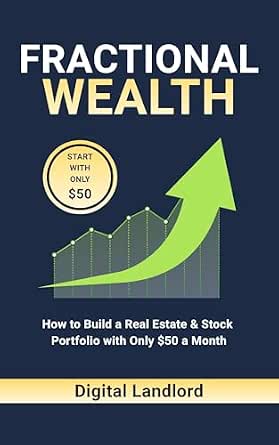
Fractional Wealth: How to Build a Real Estate & Stock Portfolio with Only $50 a Month
Fractional Wealth is the clearest fit here for readers who want a modest-contribution starting point and a mix of property and stock exposure. Its focus on strategies built around $50 a month gives beginners a concrete frame for thinking about regular investing, while the combination of real estate and stocks sets it apart from Level Up in Fractional Real Estate, which centers on rental income. That broader scope may help readers compare asset types rather than treating property as the only path. The tradeoff is that the available description gives little detail about specific platforms, risk management, or advanced approaches, and author and publication information is absent. I’d choose it for an accessible introduction, not as a substitute for platform due diligence or tailored financial guidance.
Pros:- Frames investing around a low monthly contribution that may feel approachable to beginners
- Covers both real estate and stock diversification
- Focuses on practical, low-cost entry strategies
Cons:- The available details do not identify specific platforms or explain how to compare their terms
- Advanced strategies and investment risks receive limited description
- Author and publication details are not provided
Best for: New investors with limited monthly contributions who want an introductory framework covering both fractional real estate and stocks.
Not ideal for: Experienced investors seeking detailed platform comparisons, advanced portfolio methods, or an in-depth treatment of investment risks.
- Format:Guide
- Topic:Personal finance
- Sub-topic:Investing
- Investment areas:Real estate and stocks
- Approach:Fractional investing
- Monthly contribution focus:$50
Our verdict“Choose this guide if you want a low-contribution introduction to fractional property and stock investing, but look elsewhere for detailed platform analysis.”
Tokenized Real Estate Investing Guide
Tokenized Real Estate Investing Guide has the broadest stated asset mix among these three picks: it covers fractional property, gold, and private credit. That makes it a different choice from Fractional Wealth, which pairs real estate with stocks and gives beginners a specific low-contribution frame. Here, the appeal is the chance to learn about tokenized and fractional assets beyond property; the limitation is that the available description says nothing about the guide’s depth, specific platforms, or how it handles liquidity and asset risks. I’d treat its wider scope as a useful subject-area distinction, not proof of thorough coverage. Buyers who want a focused, practical path into rental income may find Level Up in Fractional Real Estate more directly aligned with that goal.
Pros:- Covers fractional property investing
- Includes gold alongside property
- Adds private credit to its stated asset coverage
Cons:- The available information does not describe specific platforms or investment methods
- No detail is provided about liquidity, fees, or asset-specific risks
- The breadth of asset coverage may be less focused for readers interested only in real estate
Best for: Readers exploring tokenized fractional property who also want an introduction to gold and private credit as alternative assets.
Not ideal for: Buyers who need a clearly documented platform comparison, detailed risk discussion, or a focused guide to rental-income strategies.
- Format:Guide
- Primary subject:Tokenized investing
- Real estate coverage:Fractional property
- Other stated asset classes:Gold and private credit
- Investment approach:Fractional assets
- Platform details:Not provided
Our verdict“Pick this guide if tokenized property plus other fractional assets interests you, but seek a more detailed source for platform selection and risk analysis.”
Level Up in Fractional Real Estate: How to Build Rental Income to Reach Financial Freedom
Level Up in Fractional Real Estate is the most directly centered on a property-income goal: its stated subject is using fractional real estate to build rental income. That focus distinguishes it from Fractional Wealth, which also covers stocks and emphasizes a low monthly contribution, and from the Tokenized Real Estate Investing Guide, which spans several asset classes. Readers who want a property-first theme may find the framing more relevant, but the available description does not explain which platforms, ownership structures, or income risks the book covers. I’d rank it as a targeted topic choice rather than a demonstrably more detailed investing manual. The limited product information also makes it difficult to judge whether the guidance suits beginners or investors with existing portfolios.
Pros:- Keeps its stated focus on fractional real estate
- Centers the discussion on building rental income
- Connects property investing with a longer-term financial freedom goal
Cons:- No specific platforms or investment structures are identified in the available details
- The description does not explain how risks or income variability are covered
- No further product details are provided to judge depth or intended experience level
Best for: Readers whose main interest is learning how fractional real estate may fit a rental-income-focused wealth plan.
Not ideal for: Investors seeking documented platform comparisons, specific implementation steps, or coverage of multiple asset classes.
- Format:Book
- Primary subject:Fractional real estate investing
- Stated income focus:Rental income
- Stated goal:Financial freedom
- Platform details:Not provided
- Additional product details:Not provided
Our verdict“Choose this book for a rental-income-centered angle on fractional property, but look for a more specified guide if you need platform or risk details.”

How We Picked
I compared the eight titles as educational guides for choosing fractional real estate investing platforms, not as platforms that hold or manage investments. I looked at the usefulness of each stated focus for a real buyer: clarity for newcomers, attention to risk and liquidity, coverage of tokenized assets, relevance to income goals, and whether the topic helps readers think about property as part of a wider portfolio. I also considered how specific each guide’s promise is, since a focused resource can serve one question better than a broad introduction.
The ranking favors titles whose framing appears useful to the widest range of prospective investors, then gives distinct positions to beginner, conservative, and strategy-specific guides. A book title alone cannot confirm depth, accuracy, or whether platform details are current, so I do not treat any as a substitute for reviewing offering documents and platform terms. Guides focused on a narrower subject rank lower for general decision-making, but may be the better fit when that subject is the reader’s main concern.
| fractional real estate investing platform | ASIN | Format | Primary topic |
|---|---|---|---|
| The Fractional Investor: How t | B0HFG77DZV | Book | Building a real estate and hard-asset portfolio |
| Fractional Real Estate: How to | B0DP7V5GG9 | Book | Fractional real estate investing |
| Beyond the Savings Account: A | B0HJKVHCY3 | Book | — |
| Owning Pieces of Property Powe | B0FR1WYMRX | Book | Fractional real estate ownership |
| The Ultimate Guide to Fraction | B0DY5CH9KR | Book | Fractional real estate investing |
| Fractional Wealth: How to Buil | — | Guide | — |
| Tokenized Real Estate Investin | — | Guide | — |
| Level Up in Fractional Real Es | — | Book | — |
Factors to Consider When Choosing Fractional Real Estate Investing Platforms
Use a guide to sharpen your questions before opening an account, not to pick a platform on a title alone. I would compare the educational focus with the actual investment terms you plan to evaluate, especially when a guide discusses newer structures such as tokenized property.
Match the Guide to Your Starting Point
A newcomer usually needs plain explanations of ownership structure, distributions, and the difference between owning property and owning an interest in an entity. More advanced readers may get greater value from focused material on tokenization, liquidity, or portfolio construction. A common mistake is choosing the most ambitious-sounding guide before identifying the question you need answered. If you are still learning basic terms, start with a beginner-oriented resource such as Beyond the Savings Account rather than assuming an advanced strategy guide will explain the foundations. If you already understand the basics, a narrower title may save time by concentrating on your next decision.
Separate Property Exposure From Platform Structure
Fractional investing describes an access model, not a uniform legal or financial arrangement. Depending on the offering, an investor may hold shares in an entity, a debt interest, or another contractual claim tied to property. Those structures can affect voting rights, distributions, taxes, and what happens if a property is sold or a company faces trouble. Do not assume that two platforms offering fractional exposure give you the same rights. Use educational material to build a vocabulary, then read the offering documents to identify precisely what you would own.
Treat Liquidity Claims With Care
A marketplace or stated exit option does not mean you can sell whenever you want or recover the amount you invested. Resale can depend on buyer demand, platform rules, transfer restrictions, and the status of the underlying asset. Guides such as Owning Pieces of Property Power make liquidity a central topic, but readers still need to verify the mechanics for each specific offering. Check whether withdrawals are limited, whether transfers need approval, and what happens during a pause or wind-down. The tradeoff is straightforward: an easier-sounding exit route may still come with restrictions and uncertainty.
Compare Total Costs, Not Just the Entry Point
Fees can sit at several levels: account or management charges, acquisition and disposition costs, servicing expenses, and costs embedded in the property or fund. A small minimum investment does not tell you whether the overall arrangement is economical for your intended holding period. Compare how charges are calculated, when they apply, and whether they reduce distributions or the value returned at sale. Also check for tax preparation or transfer costs that may not be prominent in a short overview. A useful guide should prompt these questions, but current platform disclosures are the source to rely on.
Judge Risk Beyond the Number of Properties
Owning small pieces of several properties can still leave a portfolio concentrated in one region, property type, sponsor, or platform. Property-level risks include vacancies, repairs, insurance changes, and refinancing conditions; platform-level risks include operations, custody, and recordkeeping. A title promising a conservative approach, such as Fractional Real Estate, may help frame risk questions, but no label makes an investment low risk by itself. Map what could go wrong at both the property and intermediary level before deciding how much to allocate. Diversification across listings is not the same as diversification across risk drivers.
Check Whether the Strategy Fits Your Goal and Timeline
Rental income, long-term appreciation, and exposure to tokenized assets are different goals, and they can involve different holding periods and uncertainties. A guide focused on building rental income may be relevant to cash-flow planning, while Tokenized Real Estate Investing Guide is more tailored to readers examining digital ownership structures. Neither focus guarantees distributions, appreciation, or easy access to funds. Decide whether you need income now, potential growth over time, or simply a small learning allocation, then compare that goal with the offering’s stated term and payout policy. Avoid committing money you may need before the expected investment horizon ends.
Frequently Asked Questions
Are these eight products fractional real estate investing platforms?
No. The listed products are books and educational guides, not services where you open an account or buy an investment. They can help explain topics such as portfolio building, liquidity, and tokenization, but they do not provide platform access. Before investing, confirm that a service is a live platform and review its current legal documents, fees, eligibility rules, and asset details. Treat a guide’s discussion of a service or strategy as a starting point for your own research.
Which guide should I read if I have never invested in property before?
Beyond the Savings Account is the most explicitly beginner-focused title in this group and connects fractional real estate with putting extra cash to work. It may suit readers who want an introductory frame that also touches on tokenized assets. If your main concern is cautious wealth-building, Fractional Real Estate offers a different stated emphasis. Whichever you choose, check that the material explains ownership and risk clearly before relying on it to compare actual offerings.
Can a fractional real estate investment be sold whenever I need cash?
Not necessarily. Some offerings have fixed holding periods, limited transfer options, or resale features that depend on an available buyer and platform rules. Even where a secondary market exists, a sale may take time or occur on terms you do not control. Read the specific documents for redemption limits, transfer approvals, and any suspension rights. A guide about liquidity can help you form questions, but only the platform’s current terms describe the exit options for a particular investment.
Should I choose a tokenized real estate platform over a conventional one?
Not based on the word “tokenized” alone. Compare the legal rights attached to the token, who maintains ownership records, how transfers work, and whether the token can be sold in practice. Also examine custody, platform continuity, and what would happen to your claim if the technology provider or intermediary stopped operating. Tokenized Real Estate Investing Guide is the most directly relevant title here, but a focused guide cannot settle the legal and operational details of a specific offering. Choose based on transparent terms and a structure you understand, not novelty.
What should I verify before investing after reading one of these guides?
Read the offering documents and identify what you legally own, how returns are generated, what fees apply, and what could delay or reduce distributions. Check the property or portfolio details, sponsor track record, conflicts of interest, tax reporting, and the process for transferring or exiting your position. Confirm investor eligibility and any limits on withdrawals before sending funds. Finally, consider how the investment fits alongside your existing savings and investments, rather than treating a small minimum as proof that the risk is small.
Conclusion
For the broadest starting point, I recommend The Fractional Investor as the best overall guide because its hard-asset and portfolio framing reaches beyond one property strategy. For best value in learning breadth, Fractional Wealth pairs real estate with stocks and is framed around a small monthly contribution; for beginners, choose Beyond the Savings Account. Readers seeking a more premium, wide-angle study can start with The Ultimate Guide to Fractional Real Estate Investing, while those with a specific need should match the subject: Owning Pieces of Property Power for liquidity and risk controls, Tokenized Real Estate Investing Guide for token structures, Fractional Real Estate for a conservative framing, or Level Up in Fractional Real Estate for rental-income goals. These are guide recommendations, not endorsements of investing platforms; verify platform terms and risks independently before committing money.