
TL;DR

Get smart everyday buys delivered free with Prime
- Fast, free delivery on millions of items
- Prime Video, Amazon Music and more included
- Member-only deals all year
Building your own AI workstation used to save money, but recent component shortages and rising prices make prebuilt systems often just as affordable or better for speed and reliability. Your choice hinges on control, support, and how quickly you need the machine ready.
Imagine trying to squeeze a big, complex puzzle into a tiny box — that’s what choosing between a build or buy for your AI workstation feels like right now. Traditionally, building your own was cheaper, more customizable, and a way to get exactly what you wanted. But the landscape changed fast in 2026.
The AI boom pushed component prices sky-high, and supply chain hiccups made DIY builds more expensive and time-consuming. Meanwhile, prebuilt vendors now buy in bulk and fine-tune their systems for performance and silence, often matching or beating DIY prices. This isn’t just about saving a few bucks anymore; it’s about speed, support, and operational risk.
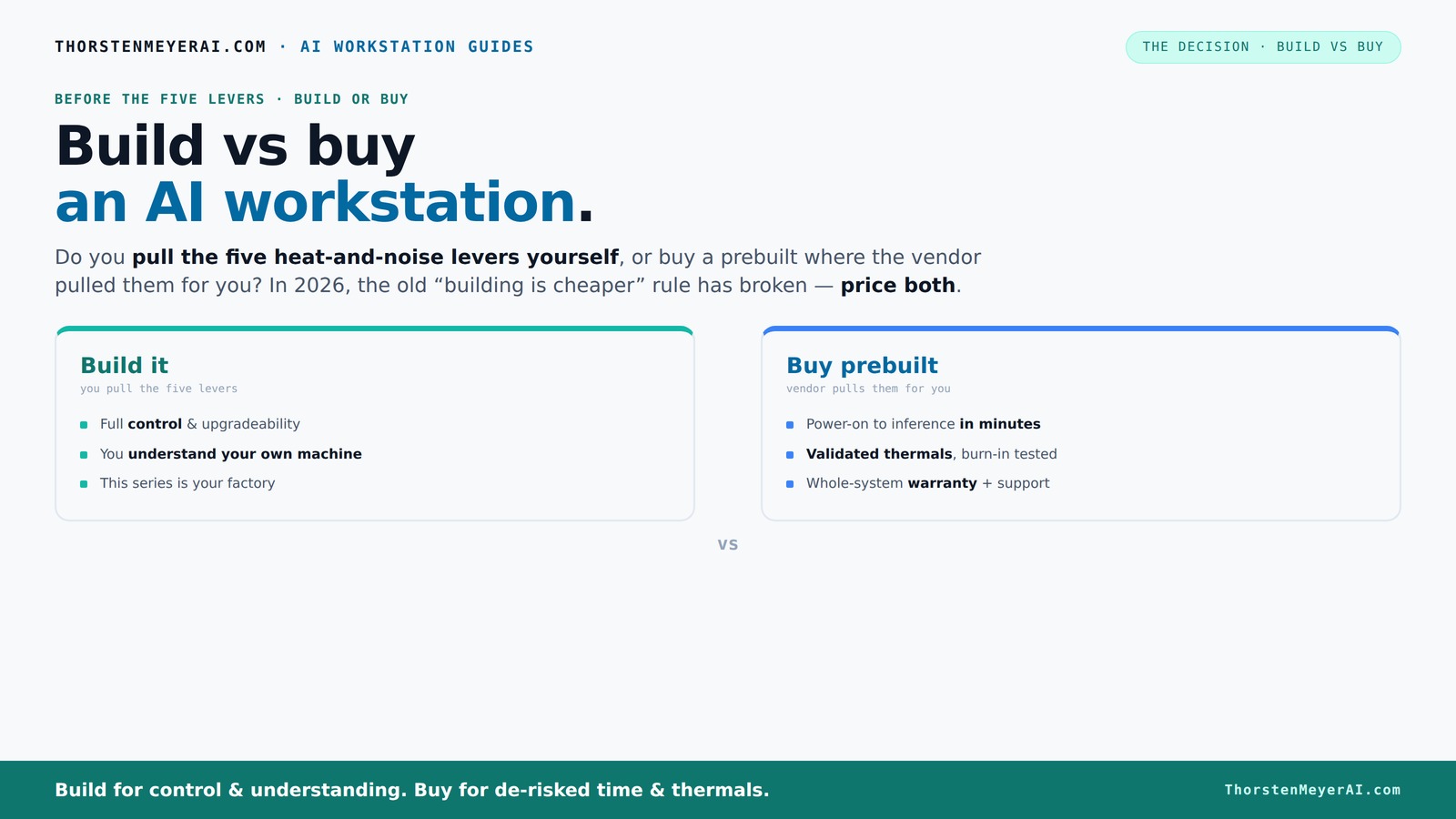
Let’s break down what you really need to know before you click ‘build’ or ‘buy’.Build vs buy
an AI workstation.
The real question behind this whole series: do you pull the five heat-and-noise levers yourself, or buy a prebuilt where the vendor pulled them for you? And in 2026, the old “building is cheaper” rule has broken. Match your situation in Part 3.
Key Takeaways
- Recent supply chain issues have leveled the playing field — prebuilt systems can cost as much or less than DIY for high-end AI workstations.
- Prebuilt vendors handle thermal tuning, testing, and support, reducing setup time and operational risk.
- DIY gives maximum control over components, cooling, and upgrade paths — but demands technical skill and time.
- Support and warranty are often better with prebuilt systems, making them more reliable for critical or professional workloads.
- Your choice depends on whether speed, support, and reliability outweigh customization and potential cost savings.
As an affiliate, we earn on qualifying purchases.
Why the old rule 'Build is Cheaper' No Longer Holds in 2026
In 2026, building your own AI workstation isn’t automatically cheaper. The reason: component shortages and soaring prices for GPUs, RAM, and SSDs. What used to cost under $1,000 now easily hits $1,250+ just for parts, before adding OS or peripherals.
But why does this matter? Because the cost of individual components has a direct impact on the feasibility of DIY. When prices spike, the savings you might have enjoyed in the past diminish or disappear altogether. Additionally, the time and effort required to assemble, troubleshoot, and optimize a DIY build become more costly—especially if you’re balancing this against a tight project deadline or operational demands.
Meanwhile, prebuilt vendors like Lambda and BIZON snapped up components early, locking in bulk prices. They now sell systems at prices that make DIY look expensive — sometimes even cheaper. This shift means that the traditional advantage of building for savings is eroding, and the decision now must consider not just cost, but also speed, reliability, and risk management. Essentially, the tradeoff is shifting from purely financial to operational and strategic considerations, where time-to-deploy and support become critical factors.
Who Pulls the Five Levers? Building vs Buying Your AI Workstation
The core challenge in high-power AI workstations is thermal management — keeping the machine cool, quiet, and stable under load. The five levers are undervolting the GPU, matching the cooler, fixing airflow, tuning fans, and proper placement. Who pulls these levers? You or the vendor.
Buy a prebuilt → the vendor handles all the levers. They validate thermals, run burn-in tests, and often include water-cooling that keeps noise and heat down. This isn’t just about convenience; it’s about ensuring the system performs reliably under prolonged heavy loads, which is crucial for consistent results in AI training or inference. Proper thermal management directly affects hardware longevity, system stability, and noise levels—factors that can significantly impact operational costs and user experience. When vendors handle these levers, they’re effectively managing the tradeoffs between performance, noise, and lifespan, reducing the risk of overheating or failure during critical workloads.
Build it yourself → you pull the levers. You choose a quiet GPU, undervolt it, pick a cooler, and set up airflow. It’s a more hands-on process, but it means your rig is tuned exactly to your needs — plus, you learn how everything works. This approach suits those who love tinkering and want total control. However, it requires a deep understanding of thermal dynamics and hardware compatibility. Poor tuning can lead to thermal throttling, increased noise, or hardware failure, which might negate the initial cost savings. The implication here is that DIY thermal management demands expertise; otherwise, it risks undermining the reliability and longevity of your system.
Defining Your Operational Needs: When to Build or Buy
Before making a decision, it’s crucial to evaluate your specific operational needs. Are you prioritizing rapid deployment to meet tight project deadlines? Do you require maximum customization for specialized workloads? Or is long-term support and reliability your top concern? Understanding these factors can help you choose the right approach.
If your team has the technical expertise and time to manage a custom build, and you value tailored configurations, building may be the better route. Conversely, if you need a system that’s ready to go out of the box, with comprehensive support and warranty, a prebuilt system might serve you better. The key is aligning your choice with your operational priorities to ensure optimal performance and minimal downtime.
Conclusion: Making the Right Choice in 2026
Deciding to build or buy your AI workstation isn’t just about parts — it’s about operational needs, support, and how fast you need to get working. In 2026, the cost gap has narrowed or even flipped, so focus instead on your workflow and comfort level.
Remember: a well-chosen prebuilt can save you time and headaches, while a DIY build offers unmatched customization for those who love tinkering. Whichever path you choose, make sure it aligns with your goals.
Frequently Asked Questions
Is a prebuilt AI workstation more expensive than building one?
Not necessarily. Due to component shortages and bulk buying, prebuilt systems often match or beat DIY prices for high-end configurations in 2026. Always compare prices based on your specific specs.When does building your own save money?
Building can save money if you already have compatible parts, plan for simple upgrades, or select budget components carefully. But rising component prices make this less certain today.What hidden costs come with DIY?
Expect to spend extra time troubleshooting, dealing with compatibility issues, and possibly upgrading components sooner. Support is decentralized, and errors can be costly in downtime.How much faster can I get started with a prebuilt system?
Prebuilts are typically ready within days, often shipped fully assembled and tested. DIY builds can take weeks, especially if sourcing parts or troubleshooting issues.Is a prebuilt workstation more reliable than a custom build?
Yes, often. Vendors rigorously test prebuilts for thermals and stability, and support is bundled. DIY systems depend on your expertise and can have more variability.Conclusion
Deciding to build or buy your AI workstation isn’t just about parts — it’s about operational needs, support, and how fast you need to get working. In 2026, the cost gap has narrowed or even flipped, so focus instead on your workflow and comfort level.
Remember: a well-chosen prebuilt can save you time and headaches, while a DIY build offers unmatched customization for those who love tinkering. Whichever path you choose, make sure it aligns with your goals.
Halloween Picks
halloween
As an affiliate, we earn on qualifying purchases.