
TL;DR

Get smart everyday buys delivered free with Prime
- Fast, free delivery on millions of items
- Prime Video, Amazon Music and more included
- Member-only deals all year
IdeaClyst creates a digital war room that combines AI council, discovery tools, and local-first data storage. It helps founders validate ideas faster, avoid costly missteps, and confidently choose the best path forward—while keeping everything private and owned by them.
Every founder faces a storm of ideas—each promising, each risky. The question isn’t just which idea is good enough, but which one deserves your next six months of effort.
Enter IdeaClyst — a digital war room that transforms the chaos into clarity. It’s like having a team of skeptical advisors, a discovery engine, and a personal workspace, all on your laptop. No cloud, no data leaks, just your raw ideas, sharpened by structured debate and real research.
A war room for your next idea
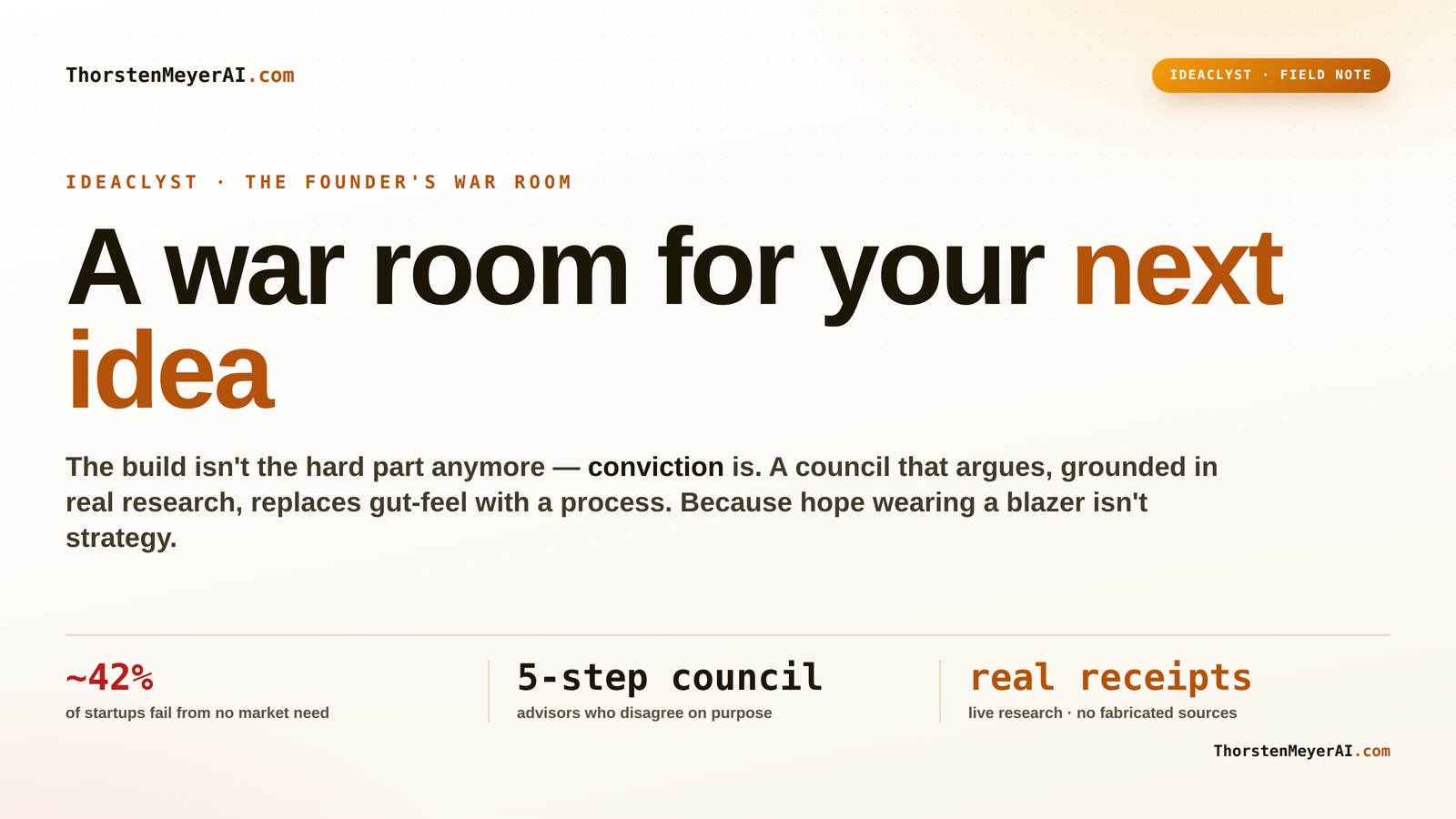
The build isn’t the hard part anymore — conviction is. Knowing which idea deserves the next six months, and being able to defend it. Most founders answer with gut feel and optimistic math. That’s hope wearing a blazer. IdeaClyst replaces it with a process.
The most expensive decision is what to build
The single most valuable thing a tool can do is talk you out of the wrong six months. The numbers make the case better than any pitch.
Three tools in one — on your own machine
Strip away the framing and IdeaClyst is three things at once, all running locally with nothing leaving your laptop.
An AI council
Pressure-tests an idea you bring it — advisors who argue on purpose.
A discovery engine
Finds ideas you didn’t know to look for by hunting real demand signals.
A founder’s workspace
Carries winners from “interesting” all the way to “ready to build.”
Advisors who disagree on purpose
Not one confident, agreeable answer — a structured five-step deliberation where models play different roles and turn on their own work. The disagreement is the feature.
The five-step deliberation
A council that leads with the bad news surfaces the objections you’d otherwise find the expensive way, on month five.
Product strategy
Who’s it for, what’s the wedge, why now, what’s the business model.
Technical architecture
What would it actually take to build — and where’s the risk.
Critique pass
The council turns on its own work. Where’s the hand-waving? What kills this?
Second, independent critique
A different voice, a different angle — so blind spots don’t survive.
Final synthesis
Everything into one coherent founder packet: strategy, architecture, validation, plan.
When IdeaClyst cites a source, it actually fetched it
The hard departure from “ask an AI what it thinks of my startup.” It runs in a strict, real-data-only mode — if it can’t gather genuine evidence, it says so plainly rather than inventing a plausible paragraph.
Confidence with receipts
No fabricated statistics, no imaginary competitors, no made-up citations. The packet survives a skeptical co-founder or a sharp investor because the reasoning has receipts.
Market research first
Scouts the landscape before the council reasons about anything.
Competitor read
Real positioning, pricing signals, feature claims — differentiation vs. reality.
Validation with links
Not “talk to customers” — concrete signals & sources you can click.
From the blank page to build-ready
Evaluation is half the problem; the blank page is the other half. And a plan is worthless if it dies in a tab you never reopen.
Bring a space, not an idea
“AI for accountants,” “tools for indie game studios” — plus your goal and real capacity. It hunts demand signals across HN, Reddit, Product Hunt, GitHub, pricing pages.
- An honest market read — leads with the bad news when a space is hard
- An opportunity map — high pain, thin competition
- Ranked candidates — wedge, who pays, effort, risk, confidence
- each with KILL CRITERIA — when to walk away
A home and a forward path
Every promising idea gets carried forward, with every artifact in plain files on your disk.
- Validation tooling — sprint board, interview list, evidence browser
- Founder profile — a personal-fit lens; same discovery, different advice
- Build workspaces — funnel, personas, landing draft, version history
- “Build this idea” → a PRD + task queue, ready for a coding agent
Key Takeaways
- A digital war room centralizes your ideas, critiques, research, and plans—saving time and reducing costly mistakes.
- IdeaClyst’s AI council stages structured debates, surfacing risks and blind spots early in the process.
- Ground your ideas in real-time web research instead of vague vibes, significantly increasing your confidence.
- Keep everything private and local-first—your ideas stay your own, without cloud dependence.
- Start small: create your own war room today to accelerate decision-making and turn uncertainty into conviction.
AI-powered idea validation software
As an affiliate, we earn on qualifying purchases.
As an affiliate, we earn on qualifying purchases.
Why a Digital War Room Changes Everything for Founders
Think of a war room as the command center for your ideas. It’s where you gather all the intel, visualize progress, and make decisions fast. But instead of a cramped conference room, it’s a sleek, private space on your computer.
For example, a startup founder might use IdeaClyst to test a new SaaS feature idea. Instead of relying solely on intuition or gut feeling, they leverage structured debate from AI advisors, backed by live web data, to objectively evaluate whether their target market truly needs this feature. This process helps uncover hidden assumptions, biases, or overlooked data that could derail the project later. The real benefit isn’t just faster decisions, but better, more informed ones—reducing the risk of costly pivots or failed launches. The tradeoff, however, is that founders must invest time in learning how to interpret and balance AI insights with their own judgment, understanding that AI is a tool—not a crystal ball. This approach emphasizes strategic thinking over blind reliance, fostering a culture of disciplined validation that can significantly improve outcomes in the long run.
How IdeaClyst’s AI Council Guides Better Decisions
IdeaClyst’s secret weapon is its AI council. Instead of a single opinion, it stages a five-step debate—each step with a different role: strategy, tech, critique, second critique, and synthesis. Imagine having five advisors arguing over your idea, each with their own lens. This layered approach is crucial because complex decisions rarely have a single correct answer. Instead, they involve weighing multiple perspectives, identifying potential blind spots, and understanding tradeoffs. For instance, when evaluating an eco-friendly app idea, one model questions the market need, revealing whether there’s genuine demand. Another assesses technical feasibility, considering what resources or expertise might be lacking. The critique roles surface risks, while the synthesis helps balance conflicting insights into a coherent plan. This multi-perspective debate surfaces risks early—saving months of development time and hundreds of thousands of dollars that might otherwise be wasted on misguided efforts. The tradeoff is that this process requires founders to be comfortable with nuanced discussions and to interpret conflicting advice thoughtfully. Ultimately, the AI council fosters a disciplined, rigorous debate that mirrors the best practices of seasoned advisors, but at a fraction of the cost and effort.
Grounding Ideas in Real-World Data, Not Vague Vibes
Many AI tools answer based on memory and trend guesses, which can be misleading. IdeaClyst avoids this trap by anchoring its advice in live web research. It pulls current data, market stats, and competitor info—so your idea’s viability is based on today’s reality. This approach is vital because market conditions are constantly changing, and relying on outdated or anecdotal data can lead you astray. For example, hearing “the market is growing fast” is vague; seeing real numbers—like a 12% annual growth rate in your niche or a recent $2 million funding round by a competitor—provides concrete evidence that can validate or challenge your assumptions. This real-time data helps you identify emerging opportunities or threats that might otherwise be missed. The implication is that your decisions become more resilient, grounded in verifiable facts, which reduces the risk of costly missteps. However, the tradeoff is that gathering and interpreting live data requires a certain level of diligence and analytical skill. Founders must learn to differentiate signals from noise and understand that data is only as good as how it’s used. Ultimately, this focus on real-world data elevates your decision-making from guesswork to strategic insight, increasing confidence and reducing uncertainty.
What’s Inside the Ultimate Idea War Room — Features That Drive Results
Picture a sleek digital workspace where every idea, critique, and plan lives in Markdown files on your disk. That’s IdeaClyst. It combines three core features:
- AI council: structured debates with multiple models playing different roles, fighting over your idea.
- Discovery engine: finds related ideas, emerging trends, and potential blind spots you didn’t see.
- Founder workspace: a clean, organized environment to write, version, and develop your plans—offline and private.
These features work together to create a cohesive environment where ideas can be challenged, refined, and validated without the distractions or risks of cloud dependency. The AI council provides rigorous critique, the discovery engine uncovers unseen opportunities, and the local workspace ensures your data remains private and easily manageable. The tradeoff here is that while this setup offers control and security, it requires a disciplined approach to organizing and maintaining your files. If done well, it results in a robust, resilient process that can be scaled or adapted over time, providing a competitive edge in fast-moving markets.
A Step-by-Step Guide to Building Your Own Idea War Room
Want to set up your own digital war room? Here’s a quick step-by-step:
- Gather your ideas: Write down your core concepts or hypotheses, ensuring clarity and focus from the start. This foundational step helps you organize your thinking and identify gaps early.
- Invite your AI council: Run your ideas through structured debates, asking for critique and validation. This process exposes weaknesses, highlights assumptions, and encourages rigorous thinking—crucial for avoiding costly mistakes later.
- Use discovery tools: Search for related ideas, market trends, or overlooked opportunities. This helps you expand your perspective, identify emerging niches, and challenge your biases.
- Organize your findings: Keep notes, critiques, and plans in Markdown files on your local machine. This ensures your data remains private, easily accessible, and version-controlled, enabling you to track changes and refine your ideas over time.
- Iterate and synthesize: Use the feedback to refine your idea, then develop a clear, actionable plan to build. This iterative process ensures your final approach is robust, validated, and aligned with real-world data.
For instance, a founder testing a new app feature can follow these steps to quickly validate the concept, uncover potential pitfalls, and craft a solid development plan—all in private, with maximum control over the process.
Who Should Use a War Room — Startups, Teams, or Solo Founders?
A war room isn’t just for big teams. Solo founders, remote teams, and small startups all benefit from a centralized space to test and develop ideas. It keeps everyone aligned, focused, and moving fast. The key is that having a dedicated space—whether physical or digital—reduces fragmentation, minimizes miscommunication, and accelerates decision cycles. For solo founders, this means a private, distraction-free environment that consolidates research, debate, and planning, enabling them to act as their own board of advisors. For remote or distributed teams, a digital war room ensures that everyone remains on the same page without the overhead of meetings or endless email chains. The tradeoff is that effective use requires discipline in maintaining the workspace and consistently updating data and critiques. Without this discipline, the process risks becoming cluttered or outdated, which can undermine its effectiveness. Nonetheless, the flexibility and scalability of a digital war room make it a valuable asset regardless of team size, ultimately fostering a culture of deliberate, strategic thinking that leads to faster, smarter decisions.
What Results Can You Expect from a Digital War Room?
Expect clarity, speed, and confidence. When you set up your own idea war room, you’ll notice faster validation of concepts, fewer costly mistakes, and a clearer path to execution. This isn’t just about quick wins; it’s about cultivating a mindset of continuous validation and disciplined decision-making. For example, a startup that used IdeaClyst to vet their MVP idea pivoted from a vague concept to a validated product within three months. This rapid validation saved them thousands of dollars in development costs and months of wasted effort chasing unviable ideas. By systematically challenging assumptions, grounding decisions in real data, and iterating quickly, founders can avoid the pitfalls of overconfidence or analysis paralysis. The tradeoff is that maintaining a war room requires ongoing effort and discipline—it’s not a one-time setup but a continuous process of refinement. Over time, however, this investment pays off by establishing a repeatable, evidence-based approach that accelerates innovation, reduces risk, and improves overall success rates.
The One Key Takeaway: Build Your Own Digital War Room Today
If you take one thing from this, it’s this: a dedicated, structured space for your ideas—whether physical or digital—can save you months and hundreds of thousands of dollars. It’s the difference between hope and conviction. Creating this space requires intentional effort but yields exponential benefits in clarity, speed, and confidence. The key is to view it as a strategic asset—an ongoing environment for disciplined validation and development. By leveraging tools like IdeaClyst, you can start small, refine your process, and scale as your needs grow. The implications are profound: better decisions, fewer costly mistakes, and a more resilient innovation pipeline. The tradeoff is that it demands consistency and discipline, but the payoff is a sustainable competitive advantage that can make or break your startup’s success.
Start small. Use tools like IdeaClyst to create your own war room, debate your ideas rigorously, and ground your decisions in real data. Your future self will thank you for it.
Frequently Asked Questions
What is IdeaClyst exactly?
IdeaClyst is a local-first, AI-powered platform that acts as a digital war room. It helps founders test, validate, and develop ideas through structured debates, real-time research, and organized planning—entirely on your own machine.Is IdeaClyst a physical space or an app?
It’s a software tool you run on your laptop. No cloud accounts or subscriptions are needed. Think of it as your private, digital war room that keeps everything local and under your control.How does a war room improve idea validation?
A war room brings structure, debate, and real data into your idea process. Instead of guessing or relying on gut feelings, you get evidence-backed insights, risk flags, and a clear plan—saving months and money.Can I use a war room if I work remotely or solo?
Absolutely. Digital war rooms like IdeaClyst are perfect for remote teams and solo founders. They create a centralized space for all your thinking, no matter where you are.What should I include in my own idea war room?
Gather your ideas, critiques, research data, and plans. Use structured debates, discovery tools, and organized markdown files to keep everything clear and evolving.Conclusion
Building a war room isn’t just for big companies or high-stakes projects. It’s a mindset—an environment where your ideas are tested, debated, and refined with clarity and speed.
With tools like IdeaClyst, you don’t need a dedicated room or a team of advisors. Just a laptop, some disciplined thinking, and a commitment to making smarter decisions faster. Your next big idea deserves that kind of focus—and your future self will thank you for it.
Fall Picks
fall essentials
As an affiliate, we earn on qualifying purchases.