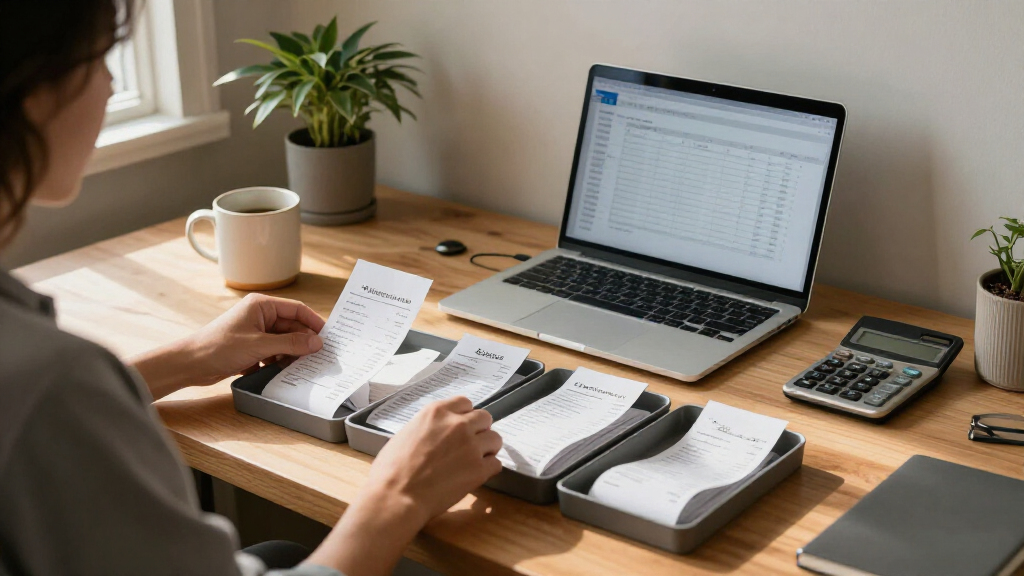
Home office expense organizers help keep bills, receipts, and tax paperwork together, but the right format depends on whether you need to track payments, file documents, or do both. I’d name the HAUTOCO Hardcover Monthly Bill Tracker Notebook my best overall pick for a recurring bill routine, while the Faccito Yearly Tax Organizer stands out for separating paperwork into tax-ready categories and the SortRax Monthly 12-Pocket Accordion File for month-by-month document filing. The main tradeoff is between written tracking and expandable storage: notebooks record what happened, while pocket organizers keep papers sorted but may not capture payment details. Read on for the full breakdown of all 15 options and how to match one to your home-office workflow.

Get smart everyday buys delivered free with Prime
- Fast, free delivery on millions of items
- Prime Video, Amazon Music and more included
- Member-only deals all year
Key Takeaways
- Trackers and file organizers solve different problems: notebooks such as the HAUTOCO and A4 Bill Payment Tracker record bill activity, while accordion files and tax folders primarily store paper.
- More pockets suit longer filing cycles: the 13-pocket SKYDUE, Sooez, and SortRax options provide more room for monthly or category-based sorting than the 8-pocket SKYDUE folders.
- The Faccito 2-pack is the clearest tax-focused choice: its 12-pocket structure and two-folder format support separating documents without relying on a single catch-all pocket.
- Small-format organizers favor portability over capacity: the portable receipt holder and Taja planner are easier to carry, but they offer less room for large paper stacks than full-size folders and notebooks.
- There is no single format that automatically handles every task: buyers who need both a payment record and paper storage may prefer pairing a tracker with a separate file organizer.




| home office expense organizer | Dimensions |
|---|---|
| Current Bill Paying Organizer | — |
| Faccito Yearly Tax Organizer | — |
| Infinnet Business Expense and | 9.5 × 6.5 inches |
| SKYDUE 13-Pocket Expanding Fil | 13 × 10 × 0.75 inches |
| Portable Receipt Organizer and | 8 × 5.1 × 0.75 inches |
| HAUTOCO Hardcover Monthly Bill | 10.78 × 8 in |
| Sooez 13-Pocket Expanding File | — |
| SortRax Monthly 12-Pocket Acco | 13 × 9.4 × 0.59 in |
| SKYDUE Expanding File Organize | 12.8 × 9.8 × 0.6 in |
| SKYDUE Expanding File Folder w | 12.8 × 9.8 × 0.6 in |
| SKYDUE 13-Pocket Expanding Fil | — |
| Adams Home Office Budget Book | 10 x 7 inches |
| A4 Bill Payment Tracker Notebo | 11 x 8.5 x 0.2 inches |
| Bill Tracker Notebook: Monthly | 8.5 x 11 inches |
| Taja Undated Budget Planner an | — |
More Details on Our Top Picks
Current Bill Paying Organizer Book, 9 × 12 in
The Current Bill Paying Organizer Book suits home-office users who want a monthly bill routine with space to keep receipts nearby. Its 14 storage pockets and 32 labels let you sort paperwork by month or category, while the finance tips and note areas add guidance beyond basic filing. Compared with the Faccito Yearly Tax Organizer, it offers a larger 9 × 12-inch working format, but Faccito supplies two organizers and is more explicitly set up for sorting a full year of tax records. Current’s spiral binding and coated cover suit recurring desk use; its drawback is the combination of a sizable footprint and only 14 listed pages, which may constrain detailed tracking. Choose it for a bill-and-receipt system, not a high-capacity archive.
Pros:- 14 pockets and 32 labels support month- or category-based filing.
- Finance tips and note space add useful context to bill tracking.
- Spiral binding and coated cover suit regular handling.
- Large pages leave room for notes and tax documents.
Cons:- The 9 × 12-inch format takes up more desk or storage space than compact organizers.
- The listed 14 pages may not provide enough room for detailed or extensive records.
Best for: Home-office users who want one roomy monthly book for household bills, receipts, and tax-related notes.
Not ideal for: People with extensive paperwork or limited desk and shelf space; the 9 × 12-inch format is sizable, and the listing specifies only 14 pages.
- Format:Monthly organizer
- Size:9 × 12 inches
- Binding:Spiral-bound
- Storage pockets:14
- Label stickers:32
- Pages:14
- Cover and paper:Coated cover stock; cardstock pages
- Special feature:Tear-resistant
- Country of manufacture:USA
Our verdict“Choose Current for a roomy monthly bill-and-receipt routine, but pick Faccito if you need two organizers for broader tax-paper sorting.”
Faccito Yearly Tax Organizer, 2-Pack, 12 Pockets
For a home office that needs a separate place for each tax season or record stream, the Faccito Yearly Tax Organizer 2-Pack offers a useful split: two spiral-bound organizers, each with 12 pockets for monthly or category-based sorting. That makes it more adaptable for separating business and personal paperwork than the single-book Current Bill Paying Organizer. The A4-format pages are designed for bills, receipts, income records, and other tax documents, while top-positioned tabs keep sections easy to reach. The tradeoff is capacity: the fastener is listed for just 12 sheets, so these organizers work best as sorting folders rather than thick document binders. Their nearly 13 × 10-inch covers also need more shelf or desk room than the compact Infinnet envelopes.
Pros:- Two organizers make it practical to separate record types or filing periods.
- Each organizer has 12 pockets for sorting by month or category.
- Spiral binding allows pages to turn for access to paperwork.
- Designed for receipts, bills, income records, and tax documents.
Cons:- Fastener capacity is listed as only 12 sheets.
- Covers measuring nearly 13 × 10 inches can take up substantial storage space.
- The set is less suited to carrying a small selection of receipts than the Infinnet envelopes.
Best for: Home-based workers who want separate organizers for business and personal tax records or for two filing periods.
Not ideal for: People who need to bind thick stacks of paperwork in one place; the fastener capacity is listed as 12 sheets.
- Pack size:2 organizers
- Pockets:12 per organizer
- Cover dimensions:About 13 × 9.65 inches
- Inside page dimensions:About 9.65 × 6.5 inches
- Paper size:A4
- Binding:Spiral
- Fastener capacity:12 sheets
- Tab position:Top
- Colors:Blue and white
Our verdict“Pick Faccito if you want two year-round tax-sorting books, but choose Current for a single bill-focused organizer with more room for notes.”
Infinnet Business Expense and Receipt Organizer Envelopes, 12-Pack, Green
The Infinnet expense envelopes are the most task-specific choice here for people who record work expenses away from their desk. Each envelope pairs 30 numbered ledger lines with space for matching receipts, and an auto mileage log on the reverse adds a practical record for business driving. At 9.5 × 6.5 inches, they fit a glove compartment or work bag more readily than the larger Faccito Yearly Tax Organizer. They also differ from the carry-focused Simpldell holder: Infinnet prioritizes writing down expenses and mileage, while Simpldell offers a zipper and wrist strap for errands. These are paper envelopes, not a rigid file; the ungummed flap does not seal, so they provide less secure storage and protection than an expanding folder.
Pros:- Pairs a numbered expense ledger with space for matching receipts.
- Mileage log on the back supports business driving records.
- 100 lb paper is designed for writing without ink bleed.
- Compact format fits a glove compartment, center console, or work bag.
Cons:- Ungummed closure does not seal the envelope.
- Paper construction offers less protection than a rigid organizer.
- Ledger space is limited to numbered lines 1–30 per envelope.
Best for: Self-employed workers, contractors, or mobile staff who need to log expenses and mileage while keeping related receipts together.
Not ideal for: People who need sealed, durable storage for sensitive or bulky paperwork; the paper envelope has an ungummed closure and no rigid protection.
- Quantity:12 envelopes
- Material:100 lb paper
- Dimensions:9.5 × 6.5 inches
- Color:Green
- Closure:Ungummed
- Ledger:Numbered expense lines 1–30
- Additional feature:Auto mileage log on the back
- Recommended uses:Expense tracking, receipt organization, and auto mileage logging
Our verdict“Choose Infinnet for on-the-go expense and mileage logs; pick the Faccito organizer for broader year-round tax-paper filing.”
SKYDUE 13-Pocket Expanding File Folder with Monthly Labels, A4 and Letter Size, Pink
When home-office expense records arrive in stacks, the SKYDUE 13-pocket expanding folder offers much more room than a notebook or envelope-based system. Its stated capacity of up to 2,000 sheets, 13 pockets, and included monthly and blank labels make it suited to separating bills, receipts, and tax documents without limiting each section to a few pages. Unlike the Faccito Yearly Tax Organizer, it is a flexible file rather than a spiral book with a listed 12-sheet fastener capacity. The folder supports both letter and A4 paper, and its rear locking hole lets it stand upright for access. The tradeoffs are its 13 × 10-inch footprint and limited format flexibility: larger documents may not fit, and water-resistant PP is not described as waterproof.
Pros:- 13 pockets and stated capacity for up to 2,000 sheets support high-volume filing.
- Includes monthly labels, blank labels, and dividers for flexible sorting.
- Rear locking hole allows upright placement for easier access.
- Water-resistant polypropylene and an elastic cord help protect papers during everyday handling.
Cons:- A 13 × 10-inch folder takes up more room than the Infinnet envelopes or Simpldell holder.
- Designed for A4 and letter-size papers, so larger documents may not fit.
- Water resistance does not mean waterproof protection.
Best for: Home-office owners and freelancers who accumulate large volumes of letter- or A4-size receipts and tax paperwork.
Not ideal for: People who need to file oversized documents or want waterproof protection; it supports A4 and letter sizes, and its material is described as water-resistant.
- Pockets:13
- Capacity:Up to 2,000 sheets
- Supported paper sizes:A4 and letter
- Material:Water-resistant polypropylene (PP)
- Dimensions:13 × 10 × 0.75 inches
- Included labels and dividers:12 monthly labels, 24 blank labels, and 12 dividers
- Closure:Elastic cord
- Color:Pink
Our verdict“Choose SKYDUE for high-volume letter- or A4-size filing; pick Current if you want a bill-tracking book with notes and finance tips.”
Portable Receipt Organizer and Coupon Holder with 12 Pockets
The Simpldell Portable Receipt Organizer is the compact carry option for home-office users who sort receipts and bills while running errands or traveling. Its 12 accordion pockets fit A6-size paper, and a zipper helps keep loose items contained; the adjustable wrist strap makes it easier to carry without a larger bag. Compared with the Infinnet expense envelopes, Simpldell is better for carrying mixed items such as coupons, cash, and notes, while Infinnet adds a written expense ledger and mileage log. This is not a substitute for a desk filing system like the SKYDUE 13-Pocket Expanding Folder: its small format cannot hold full-size A4 or letter paperwork, and its plastic construction offers less of a paper-based filing feel.
Pros:- 12 pockets sort small receipts, coupons, cash, and notes.
- Zipper closure helps keep loose papers and items contained.
- Adjustable wrist strap supports hand carrying.
- Compact 8 × 5.1-inch size fits in a bag.
Cons:- Limited to A6-size paper, unlike the SKYDUE folder’s letter and A4 support.
- Does not include an expense ledger or mileage log like Infinnet.
- Plastic and polypropylene construction may not suit buyers seeking a paper organizer.
Best for: People who collect small receipts, coupons, and cash during errands and want to keep them sorted in a compact carry organizer.
Not ideal for: Home-office filers who need to store full-size bills, tax forms, or letter- and A4-size documents.
- Pockets:12
- Dimensions:8 × 5.1 × 0.75 inches
- Material:Plastic, polypropylene (PP)
- Color:Black and gray
- Closure:Zipper
- Strap:Adjustable wrist strap
- Supported paper size:A6
Our verdict“Choose Simpldell for carrying and sorting small receipts on errands, but use SKYDUE for full-size home-office and tax records.”
HAUTOCO Hardcover Monthly Bill Tracker Notebook, 10.78 × 8 in, Deep Purple
For a home office where expense control depends on recording due dates and payments, the HAUTOCO bill tracker offers more structure than a folder alone. Its sections for amounts, payments, and balances create a written record of what is due and what has cleared, while the lay-flat binding makes entries easier to add at a desk. Two pockets can hold bills or receipts alongside the ledger. Compared with the SortRax 12-pocket accordion file, this notebook prioritizes tracking transactions rather than sorting a stack of documents by month; the two can also work together. The tradeoff is portability: at 10.78 × 8 inches and 1.23 pounds, it is less convenient to carry than the slim SKYDUE folders. Its calendar pages also cover 2025–2027, which may limit their usefulness later.
Pros:- Dedicated sections track due dates, amounts, payments, and balances.
- Lay-flat double-wire binding supports comfortable writing at a desk.
- Two storage pockets keep bills and receipts with the ledger.
- 120 pages provide 3,000 line entries for ongoing records.
Cons:- The 2025–2027 calendar pages have a limited date range.
- Its 10.78 × 8-inch format and 1.23-pound weight are less portable than the SKYDUE folders.
- A notebook records expense details but does not sort or protect a large document stack like an expanding file.
Best for: Home-office workers or small-business owners who want a written record of bill due dates, payments, and balances, with pockets for related paperwork.
Not ideal for: People who mainly need to file large batches of receipts or carry their records daily; this notebook is bulkier than the expanding folders and is not a high-capacity file.
- Dimensions:10.78 × 8 in
- Pages:120
- Line entries:3,000
- Paper weight:100 gsm
- Cover and binding:PU leather hardcover; double-wire spiral that lays flat 360°
- Storage:2 large pockets
- Planning pages:2025–2027 calendar, yearly financial goals, and notes
- Weight:1.23 lb
Our verdict“Choose this notebook if recording bill activity matters more than carrying a large volume of paperwork.”
Sooez 13-Pocket Expanding File Organizer for Letter and A4 Documents
When home-office records build up across the year, the Sooez 13-pocket organizer is the strongest bulk-filing choice in this group. Its stated capacity of over 1,500 sheets and expansion to 14 inches suit tax paperwork, invoices, and receipts that outgrow a slim folder. Monthly tabs give each period a place, while the raised pockets keep labels visible when the file is full. Compared with the SortRax, which has 12 pockets and a 100-sheet capacity, Sooez is better suited to accumulated paperwork than light, compact storage. The tradeoff is a thinner 0.1 mm cover, so the filled organizer may need gentler handling than a rigid box. It also only fits Letter and A4 documents, leaving larger forms outside its intended use.
Pros:- 13 pockets with monthly divider tabs support chronological filing.
- Capacity of over 1,500 sheets handles far more paperwork than the SortRax.
- Raised pockets help keep labels visible when sections are filled.
- PVC-free, acid-free materials and reinforced edges support regular filing.
Cons:- The 0.1 mm cover is relatively thin and offers less protection than a rigid case.
- Expansion to 14 inches can make a full organizer bulky to store.
- Designed for Letter and A4 documents, not larger paperwork.
Best for: Freelancers, small-business owners, and home-office users who keep substantial monthly records and need a high-capacity filing system.
Not ideal for: People seeking a rigid document case, a folder for oversized forms, or a very compact organizer for a small receipt collection.
- Number of pockets:13
- Capacity:Over 1,500 sheets
- Maximum expansion:14 in
- Supported paper sizes:Letter (8.5 × 11 in) and A4
- Materials:100C polyester and polypropylene; PVC-free and acid-free
- Cover thickness:0.1 mm
- Closure:Three-loop elastic band
- Warranty:1 year
Our verdict“Pick the Sooez if your main need is keeping a large volume of monthly home-office paperwork sorted in one expanding file.”
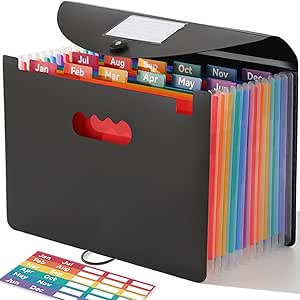
SortRax Monthly 12-Pocket Accordion File Organizer, Letter/A4, Black
The SortRax 12-pocket file makes monthly sorting straightforward: one compartment for each month, with bright tabs and labels to identify what belongs where. That setup suits home-office users who want to separate receipts, invoices, and bills as they arrive, then retrieve a specific month without flipping through a ledger. Its stated 100-sheet capacity keeps it better matched to a modest paperwork stream than the much larger Sooez 13-pocket organizer, which holds over 1,500 sheets. The SortRax also folds to a slim 0.59-inch profile for storage. Its limit is equally clear: it is a flexible folder, not a protective box, and the 100-sheet capacity leaves little room for a business that retains extensive records. Like the SKYDUE folders, it is restricted to Letter and A4 papers.
Pros:- 12 pockets provide a separate compartment for each month.
- Bright tabs, month and blank labels, and a cover card aid identification.
- Folds to a slim 0.59-inch profile for storage.
- Adjustable elastic closure helps keep documents in place.
Cons:- The 100-sheet capacity is far below the Sooez organizer’s stated capacity.
- Flexible polypropylene does not provide the structure of a rigid storage box.
- Fits Letter and A4 documents only.
Best for: Home-office users who want a compact, month-by-month place for a manageable stack of receipts, bills, and invoices.
Not ideal for: Businesses with large document archives or anyone who needs rigid protection for papers; its stated capacity is 100 sheets and its body is flexible.
- Number of pockets:12
- Capacity:100 sheets
- Supported paper sizes:A4 and Letter (8.5 × 11 in)
- Material:Polypropylene (PP)
- Dimensions:13 × 9.4 × 0.59 in
- Closure:Adjustable elastic
- Included labels:Month and blank labels; cover card
- Warranty:1 year
Our verdict“Choose the SortRax for tidy monthly filing of a modest document load when compact storage matters more than bulk capacity.”
SKYDUE Expanding File Organizer, 8 Pockets, Letter and A4 Size, Blue
For someone who carries expense papers between a home workspace and an accountant or filing cabinet, the blue SKYDUE eight-pocket organizer keeps the system light and simple. It weighs 5 ounces, fits Letter and A4 documents, and uses sticker labels to divide receipts or paperwork by category. The snap closure is a direct way to keep loose sheets contained while traveling. Compared with the SortRax, it has four fewer pockets and no month-specific labeling, so it suits fewer, broader categories rather than a full year of monthly filing. Its 200-sheet fastener capacity gives it more stated room than the olive-green SKYDUE model’s 100-sheet capacity, though it remains a slim folder rather than a high-volume archive like the Sooez. The three-month warranty is also shorter than the other listed organizers’ one-year coverage.
Pros:- Eight pockets and included sticker labels support category-based sorting.
- At 5 ounces, it is easy to carry in a bag or store in a cabinet.
- Snap closure helps keep loose papers contained.
- Fits both A4 and Letter-size documents.
Cons:- Eight pockets offer less separation than the SortRax’s 12 monthly compartments.
- Its 0.6-inch profile limits storage compared with the Sooez high-capacity file.
- Three-month warranty is shorter than the one-year coverage listed for SortRax and Sooez.
Best for: Mobile home-office workers who need a lightweight folder for separating a few categories of bills, receipts, or client documents.
Not ideal for: People who want a pocket for every month, need high-volume storage, or prefer a longer warranty period.
- Number of pockets:8
- Material:Polypropylene (PP)
- Supported paper sizes:A4 and Letter (8.5 × 11 in)
- Dimensions:12.8 × 9.8 × 0.6 in
- Weight:5 oz
- Fastener capacity:200 sheets
- Closure and features:Snap closure, expandable design, sticker labels
- Warranty:3 months
Our verdict“Pick this SKYDUE folder for lightweight, portable category filing rather than a full monthly or high-volume archive.”
SKYDUE Expanding File Folder with 8 Pockets, Olive Green
The olive-green SKYDUE is a straightforward pick for a home office that wants basic paper separation with a 100% recycled-content folder. Its eight pockets and sticker labels can divide receipts, bills, and invoices by category, while the snap closure helps prevent loose sheets from slipping out. Like the blue SKYDUE, it weighs 5 ounces and fits A4 and Letter documents, so the choice between them comes down to the stated capacity and material detail: the blue version lists a 200-sheet fastener capacity, while this one lists 100 sheets and specifies recycled content. For month-by-month filing, the SortRax is a clearer fit with its 12 dedicated pockets; for a large archive, the Sooez has much greater stated capacity. This folder stays portable, but its capacity is modest and the warranty is three months.
Pros:- Eight pockets separate documents into categories.
- Made with 100% recycled content.
- Lightweight 5-ounce design with a snap closure for carrying.
- Includes sticker labels and fits A4 and Letter documents.
Cons:- Capacity is limited to 100 sheets.
- Eight pockets do not provide the month-by-month sorting offered by the SortRax.
- Three-month warranty is shorter than the one-year coverage listed for Sooez and SortRax.
Best for: Eco-conscious home-office users who want a lightweight, labeled folder for a small collection of routine expense papers.
Not ideal for: People who retain many invoices or want one compartment per month; its 100-sheet capacity is lower than the blue SKYDUE’s listed 200-sheet capacity.
- Number of pockets:8
- Material:Polypropylene (PP)
- Recycled content:100%
- Dimensions:12.8 × 9.8 × 0.6 in
- Weight:5 oz
- Supported paper sizes:A4 and Letter (8.5 × 11 in)
- Capacity:100 sheets
- Closure and accessories:Snap closure and sticker labels
- Warranty:3 months
Our verdict“Choose the olive-green SKYDUE for light, category-based expense filing when recycled content matters and your paper volume is low.”
SKYDUE 13-Pocket Expanding File Organizer, Letter and A4 Size, Purple
For a home office where receipts, invoices, and tax documents arrive on paper, this 13-pocket file offers more separation than a notebook can. Monthly tabs and writable labels make it easier to set up a filing routine, while the upright format keeps categories visible on a desk or shelf. Compared with the Faccito Yearly Tax Organizer, this is a broader everyday filing option rather than a dedicated tax-season system. Its polypropylene body is lightweight and waterproof, and the adjustable closure helps hold papers in place when the file is full. The tradeoff is footprint: it can expand to 12 inches wide, so it needs room on a desk. Capacity figures also conflict in the listing, which states both 900 and 2,000 sheets.
Pros:- Thirteen pockets support separate monthly or document categories
- Monthly tabs and writable labels make the filing system adaptable
- Waterproof polypropylene helps protect paperwork from spills
- Adjustable closure and fold-down design aid storage and carrying
Cons:- Listing gives conflicting capacity figures of 900 and 2,000 sheets
- Can expand to 12 inches wide and occupy substantial desk space
- Stores paper rather than providing a place to record expense details
Best for: Home-office workers who receive paper bills and receipts throughout the year and want monthly categories they can label themselves
Not ideal for: People with limited desk or shelf space, or buyers who need a clearly specified sheet capacity before purchasing
- Brand:SKYDUE
- Model:1011WJJ-Purple
- Pockets:13
- Supported paper sizes:Letter and A4
- Maximum expanded width:12 inches
- Material:Polypropylene (PP)
- Included accessories:Monthly tabs and blank writable labels
- Capacity stated:900 sheets in specifications; up to 2,000 sheets in description
Our verdict“Choose this if you want a labeled, reusable paper filing system for home-office expenses and have room for its expanded width.”
Adams Home Office Budget Book, Weekly and Monthly Format, 10 x 7 Inches, White
This ledger-style book suits a home-office budget that needs regular check-ins rather than a dedicated filing system. Its weekly and monthly tracking lets buyers follow spending at two levels, while the yearly summary provides a place to gather the bigger picture. Compared with the Taja Undated Budget Planner and Expense Tracker, the Adams book is the more straightforward choice: it focuses on spending records instead of adding separate debt, savings, and bill-payment trackers. That simplicity can make routine entries easier, but the available product details do not specify page count or other organizational extras. It also depends on manual recordkeeping, unlike a pocketed file that can hold receipts without requiring each expense to be written into a ledger.
Pros:- Combines weekly and monthly spending formats
- Yearly summary supports a broader view of household or office spending
- Ledger-style layout keeps the task focused on recording expenses
- 10 x 7-inch format offers a defined writing surface
Cons:- No receipt pocket or document storage is specified
- Page count and detailed layout are not provided
- Requires manual entries and does not offer the wider set of trackers found in the Taja planner
Best for: Home-office users who want a basic paper ledger for reviewing weekly spending and summarizing it by month and year
Not ideal for: Buyers who need dedicated receipt storage, detailed bill-payment sections, or tracking for debt and savings goals
- Format:Weekly and monthly
- Dimensions:10 x 7 inches
- Color:White
- Style:Ledger
- Included summary:Yearly summary
- Primary use:Personal spending tracking
Our verdict“Pick the Adams book if you want a simple weekly-to-yearly spending ledger without extra planning sections.”
A4 Bill Payment Tracker Notebook with Annual Overview and Storage Pocket
Home-office expenses often include recurring services as well as one-off purchases, and this notebook gives those repeating payments dedicated space. Its monthly bill records, annual overview, and sections for subscriptions and automatic payments make it more focused on payment schedules than the Adams Home Office Budget Book, which tracks spending weekly and monthly. The transparent storage pocket adds a practical place for statements or receipts, while the spiral binding supports lay-flat writing. At 11 x 8.5 inches, its A4-sized page area gives room for entries but takes more desk or shelf space than the compact Taja Undated Budget Planner. The page count is not specified, so buyers cannot tell how long the notebook will last from the supplied details.
Pros:- Combines monthly bill records with an annual overview
- Dedicated subscription and automatic-payment tracking
- Transparent pocket holds related receipts and statements
- Spiral binding supports easy page turning and lay-flat writing
Cons:- A4 dimensions require more storage space than a smaller planner
- Total page count is not specified
- Focuses on bills rather than broad expense, debt, and savings tracking
Best for: Home-office users managing recurring utility, software, phone, and subscription payments who want paper records and a place for related documents
Not ideal for: People who need a compact planner or want a confirmed page count before choosing a long-term record book
- Brand:TISITEHELOL
- Size:A4
- Dimensions:11 x 8.5 x 0.2 inches
- Binding:Black spiral
- Cover:300 gsm coated paper
- Interior paper:100 GSM
- Weight:9.9 ounces
- Pages include:Annual overview, subscription and auto-pay tracking, bill records
- Storage:Transparent pocket before the back cover
Our verdict“Choose this notebook if recurring bills and subscription records matter more to your home-office system than compact size or broad budget tracking.”
Bill Tracker Notebook: Monthly Bill Payment Checklist, 8.5 x 11 Inches, 100+ Pages
This notebook is a straightforward option for people who want to mark bills off as they are handled. The monthly payment checklist centers the routine on due bills and completion, while its 100+ pages offer space for ongoing use. Compared with the A4 Bill Payment Tracker Notebook, it is less detailed on paper: the supplied description does not mention subscription tracking, an annual overview, or a pocket for statements. That makes this a simpler fit for users who already know which bills to track and want a repeatable checklist rather than a wider recordkeeping system. Its 8.5 x 11-inch format provides ample writing room, but it is not a compact notebook, and the available details do not specify binding or paper features.
Pros:- Monthly checklist gives bill payments a clear recurring workflow
- More than 100 pages support continued tracking
- 8.5 x 11-inch format leaves room for writing
- Simple purpose avoids extra sections that may go unused
Cons:- No annual overview or subscription tracking is specified
- No receipt pocket or document-storage feature is listed
- Large page size takes more storage space than the Taja planner
Best for: Home-office workers who want a large-format monthly checklist to keep routine bill payments visible and mark them complete
Not ideal for: Buyers who need annual summaries, subscription and auto-pay categories, receipt storage, or a smaller notebook
- Format:Notebook
- Purpose:Monthly bill payment tracking
- Dimensions:8.5 x 11 inches
- Pages:100+
- Tracking layout:Monthly bill payment checklist
- Binding:Not specified
Our verdict“Pick this if a roomy monthly checklist is enough for your bill routine and you do not need the extra records offered by the A4 tracker.”
Taja Undated Budget Planner and Expense Tracker, 6.9 x 9.9 Inches, 150 Pages, Pink
Among these paper options, the Taja planner covers the widest range of personal and home-office budgeting tasks in one book. Alongside monthly budget and calendar pages, it includes trackers for income, expenses, debt, savings goals, and bill payments. That makes it more flexible than the Adams Home Office Budget Book, which focuses on weekly and monthly spending plus a yearly summary, and more compact than the large-format bill checklist. Because it is undated, buyers can start whenever they like without leaving dated pages unused. The tradeoff is that dates must be filled in, and every entry requires manual upkeep. Its pocket and elastic band help contain loose papers and keep the planner closed, while the included guidebook offers budgeting instructions.
Pros:- Tracks income, expenses, debt, savings goals, and bill payments
- Undated pages can be started at any point in the year
- Elastic band and dual-sided pocket help secure the planner and loose papers
- Includes a budgeting guidebook and three sticker sheets
Cons:- Dates must be entered by the user
- Manual tracking requires regular writing and maintenance
- Pocket storage is not a substitute for the multi-category paper capacity of an expanding file
Best for: People managing home-office and household cash flow together who want one writable planner for expenses, bills, debt, and savings goals
Not ideal for: Buyers who prefer automatic digital tracking, pre-filled dates, or a dedicated file for storing large amounts of receipts
- Brand:Taja
- Model:T010
- Color:A-Pink
- Format:Undated organizer
- Paper size:6.8 x 9.8 inches
- Binding:Spiral-bound
- Pages:150
- Included accessories:Three sticker sheets and a guidebook
- Features:Elastic band, dual-sided pocket, monthly budget pages, financial trackers
Our verdict“Choose the Taja planner if you want one compact, undated book for hands-on tracking across bills, expenses, debt, and savings.”
How We Picked
I compared these 15 organizers by the job they perform: recording bill due dates and payment activity, sorting receipts, filing monthly paperwork, or keeping tax documents grouped. I gave more weight to practical fit for recurring home-office expenses, including usable pocket or page structure, compatibility with common letter and A4 documents where stated, portability, and whether the format supports a repeatable routine. Product details supplied for this roundup do not establish material durability or long-term performance, so I did not treat those as proven advantages.
The ranking favors options with a clear, broadly useful role and a workable filing or tracking structure. Picks with a specific strength, such as tax sorting, monthly pockets, or a compact format, rank well for that task but not as universal solutions. Similar products are separated by their stated pocket count, format, and intended use; when two options offer much the same job, I give the advantage to the one with a more clearly defined workflow. The best choice still depends on whether paper storage or written tracking is the reader’s main need.
Factors to Consider When Choosing Home Office Expense Organizers
Before choosing, decide what tends to go wrong in your current system: missed payments, misplaced receipts, or paperwork that is hard to retrieve at tax time. The distinctions below can help you choose a format that fits your routine instead of buying extra pockets or pages you will not use.
Choose Between Recording Activity and Storing Paper
A tracker and a file organizer are not interchangeable. A notebook can give you a written place to mark bills and payments, but it will not neatly hold a growing stack of receipts unless it includes a storage pocket. An accordion folder keeps papers grouped, yet it may not tell you whether a bill was paid or when. Buyers often expect one item to handle both jobs and then leave half the workflow unsupported. If you need reliable records and document storage, plan for two complementary tools or choose a format whose details explicitly cover both.
Match Pocket Count to Your Filing Cycle
More pockets can support a month-by-month system, but pocket count only helps when the labels match how you retrieve documents. A 12-pocket organizer might be used for months, expense types, or a combination, so decide on a scheme before filing starts. Fewer pockets may work better for a simple split such as current bills, paid bills, receipts, and tax papers. A common mistake is choosing the largest capacity and then creating categories that are too broad to be useful. Think about the number of documents you handle and how often you need to find them, not just the number of compartments.
Check Document Fit and Paper Volume
Letter and A4 compatibility matters if you keep invoices, statements, or printed tax forms; a narrow receipt holder is a different tool from a full-size file. Also consider whether your paperwork arrives as small slips, folded statements, or multi-page documents, since a pocket that accepts one format may be awkward for another. If you regularly accumulate several months of papers, a slim portable holder may fill quickly. On the other hand, a large organizer can take up desk or shelf space when your records are mostly digital. Estimate a typical month’s paper volume before choosing capacity.
Build the Routine Around Due Dates and Tax Time
For recurring bills, choose a process you can repeat: note the due date, record payment, and file the supporting document in a consistent place. For tax preparation, separating receipts and forms by category or period can reduce the sorting work later, but a tax folder is not a substitute for retaining records in the way your tax situation requires. Avoid leaving documents in an unlabeled catch-all pocket; it can move the sorting burden to year-end. A monthly filing habit tends to work better when the organizer’s structure mirrors the order you already use to review expenses. Pick a format that makes the next action obvious.
Decide Whether Portability or Capacity Matters More
A compact organizer is easier to carry between a desk, home, and an appointment, while a larger notebook or expanding file can accommodate more paperwork and provide more room to write. The tradeoff is not just size: portable formats can encourage frequent use, but limited capacity may require regular clearing. A larger organizer can keep a longer record together, though it may be less convenient to bring along. Do not pay for a bigger format solely because it sounds more capable if your records are primarily digital. Choose based on where you will actually update and retrieve it.
Spend More Only for a Workflow You Will Use
For this category, useful value comes from a structure that reduces missed steps, not from the highest page or pocket count alone. A dedicated bill notebook may be a better fit than a broad budget planner if you only need payment tracking; a tax organizer may be more useful than a general receipt envelope when year-end sorting is your main task. Before choosing a more elaborate format, list the records you need to keep and the actions you want to track. A beginner can start with one clear monthly system and add a second tool only when a real gap appears. This avoids paying for overlapping organizers that divide paperwork rather than simplify it.
Frequently Asked Questions
Should I choose a bill tracker notebook or an expanding file organizer?
Choose a bill tracker notebook if your main problem is remembering due dates or recording whether bills were paid. Choose an expanding file organizer if your main problem is keeping statements, receipts, and forms sorted and retrievable. A folder does not automatically create a payment history, and a notebook does not necessarily provide enough paper storage. If you need both records and documents, a separate tracker and file can make each task easier to maintain. Let the gap in your current process decide which one you buy first.
Is a 12- or 13-pocket organizer better for home-office expenses?
It depends on your filing method rather than the number alone. Twelve pockets can map neatly to months, while a 13-pocket design may give you an extra place for annual forms or uncategorized papers. Neither count helps much if you file by expense type and need a different set of categories. Before buying, write down the labels you plan to use and confirm the organizer can accommodate them. Choose the smaller system if it keeps your categories clearer and easier to maintain.
Can a receipt organizer replace a tax organizer?
A receipt organizer can keep slips together, but it may not provide the category structure needed to prepare tax records. A tax-focused organizer is generally a better match when you need to group documents by tax year or expense type. Check whether your receipts are small enough to fit and whether you also need space for forms or larger statements. These tools help organize records; they do not determine which records your circumstances require you to keep. If you need both receipt storage and tax grouping, choose a system that clearly supports both or use separate organizers.
Do I need a paper organizer if I keep most expense records digitally?
Not necessarily. A paper organizer can still help with original receipts, mailed statements, or documents you need to review away from a screen, but it may add clutter if nearly everything is digital. A compact receipt holder can serve as a temporary collection point while you scan and file documents. Set a regular date to process that paper so the holder does not become a permanent pile. If you rarely handle paper, a small physical organizer is likely more practical than a large expanding file.
What is the best setup for someone who is starting to track home-office expenses?
Start with the single task most likely to cause problems: recording bill payments or storing receipts and statements. A straightforward bill tracker can establish a recurring review habit, while a labeled folder can make document filing less ad hoc. Avoid splitting records across several organizers before you know which categories you use regularly. Keep a consistent monthly routine and add another tool only if you find a specific gap, such as no place for tax documents. This approach keeps a beginner’s system simple without limiting future organization.
Conclusion
For most buyers who want a dedicated recurring-bill record, I’d choose the HAUTOCO Hardcover Monthly Bill Tracker Notebook as the best overall fit. The best value for a paper-sorting workflow is the SKYDUE 13-Pocket Expanding File Folder, while the Faccito Yearly Tax Organizer 2-Pack is my best premium-style pick for buyers who want a tax-focused setup with two folders. Beginners who need a clear place to record bill activity can start with the A4 Bill Payment Tracker Notebook; for receipts on the move, choose the Portable Receipt Organizer and Coupon Holder. If your priority is month-by-month storage rather than writing down payments, the SortRax 12-Pocket Accordion File is the more fitting choice. Match the organizer to the task you need to fix first, and add a second format only when your workflow calls for it.