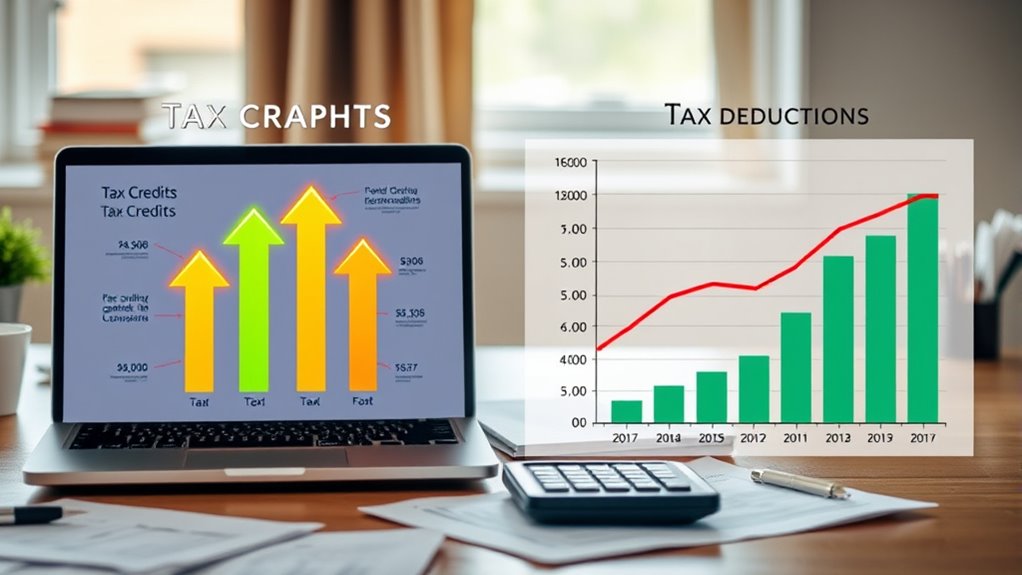

Tax credits and deductions both lower your tax bill but in different ways. Deductions reduce your taxable income, meaning you pay less tax based on your marginal rate, while credits directly cut your total tax owed, sometimes even resulting in a refund for refundable credits. Understanding how each works helps you plan wisely and maximize savings. To get a clearer picture of how they can work for you, keep exploring these options.
Key Takeaways
- Tax deductions reduce taxable income, lowering the amount on which you pay taxes, while credits directly decrease the total tax owed dollar-for-dollar.
- Deductions depend on expenses like mortgage interest or charitable contributions, whereas credits are fixed amounts such as child or education credits.
- Credits provide an immediate reduction in tax liability and can be refundable, resulting in a refund if they exceed owed taxes; deductions do not.
- Deductions benefit higher-income taxpayers more in higher tax brackets, while credits offer consistent savings across income levels.
- Understanding whether a benefit is a deduction or a credit helps optimize tax planning and maximize overall savings.

Understanding tax credits and deductions is essential for maximizing your tax savings and reducing your overall liability. These tools are designed to help you keep more of your hard-earned money by lowering the amount of tax you owe. While they both serve to decrease your tax bill, they do so in different ways, and understanding these differences can markedly impact your financial benefits.
Tax deductions work by reducing your taxable income. Think of deductions as income offsets—they lower the amount of your income that’s subject to taxation. For example, if you earn $50,000 and qualify for $5,000 in deductions, your taxable income drops to $45,000. This means you pay taxes on a smaller income, which can lead to substantial savings, especially if you’re in a higher tax bracket. Deduction types vary widely, including mortgage interest, charitable contributions, and medical expenses. They’re straightforward and often dependent on your specific expenses and circumstances.
On the other hand, tax credits directly reduce the amount of tax you owe dollar-for-dollar. If you qualify for a $1,000 tax credit, your tax bill decreases by $1,000, regardless of your income level or tax bracket. This makes credits particularly valuable, especially when they are refundable, meaning if the credit exceeds your tax liability, you can receive the difference as a refund. Common examples include the Earned Income Tax Credit, Child Tax Credit, and education credits. Since credits directly impact the final amount you pay, they often provide more immediate financial benefits compared to deductions.
Understanding the distinction is vital because deductions are influenced by your marginal tax rate. For instance, a $1,000 deduction saves you more if you’re in a higher tax bracket than in a lower one. Conversely, credits offer a fixed reduction regardless of your income level, making them especially advantageous for lower- and middle-income taxpayers. When planning your taxes, knowing whether a benefit is a deduction or a credit helps you strategize better. For example, if you’re eligible for a credit, it might be worth prioritizing expenses that qualify for that credit. Additionally, being aware of sound design techniques can help you create more engaging and immersive media content, which can be beneficial if you work in media production or related fields.
Frequently Asked Questions
Can I Qualify for Both Tax Credits and Deductions Simultaneously?
Yes, you can qualify for both tax credits and deductions simultaneously. Your eligibility requirements for each depend on specific criteria, such as income level or expense type. Make certain to gather the necessary documentation, like receipts or proof of expenses, to support your claims. Filing accurately and consulting IRS guidelines can help ensure you maximize both benefits without errors, potentially lowering your tax bill considerably.
How Do I Determine Which Is More Beneficial for My Situation?
To determine which is more beneficial, compare the benefit potential of tax credits versus deductions based on your situation. Consider eligibility factors like income level and filing status, as credits directly reduce your tax bill, often providing greater savings, while deductions lower your taxable income. Review your financial details and run scenarios or consult a tax professional to see which option offers the maximum benefit comparison tailored to your circumstances.
Are There Income Limits for Claiming Certain Tax Credits?
Yes, some tax credits have income limits due to income phaseouts and credit thresholds. As your income increases, you might lose eligibility or see a reduced benefit. For example, the Child Tax Credit and Earned Income Tax Credit have specific thresholds that determine your eligibility. To maximize your benefits, check the latest IRS guidelines, and consider how your income level impacts your ability to claim these credits.
Do Tax Credits or Deductions Impact State Taxes Differently?
Like a tale of two cities, tax credits and deductions impact your state taxes differently. Tax credits directly reduce your state tax bill dollar for dollar, similar to a knight’s shield, while deductions lower your taxable income, affecting your federal impact more. So, when planning, remember that credits give immediate relief at the state level, but deductions mainly influence your federal taxes, making both essential tools in your financial arsenal.
How Often Do Tax Laws Regarding Credits and Deductions Change?
Tax laws regarding credits and deductions change fairly often, with updates happening annually or during specific legislative sessions. You should stay informed about tax law updates and legislative changes because they can affect your filings. Tax authorities usually announce these updates ahead of time, so you can prepare accordingly. Checking official IRS notices or consulting a tax professional helps guarantee you’re aware of recent changes that might impact your deductions or credits.
Conclusion
Now that you understand the difference between tax credits and deductions, you hold the keys to maximizing your savings. Think of them as two powerful tools in your financial toolbox—each with its own purpose. By using them wisely, you can turn the tide of your tax season from a storm into a breeze. Remember, knowledge is your greatest ally; arm yourself well, and watch your hard-earned money grow.