
After a disaster, your donations can offer both social impact and tax benefits. To maximize your deductions, make certain you give to qualified organizations and get proper documentation like receipts or acknowledgment letters. Keep in mind that limits apply based on your AGI, and excess contributions can often be carried forward for future deductions. Timing your donations before year-end and understanding special rules for disaster relief efforts can help you optimize your tax advantages when supporting those in need.
Key Takeaways
- Donations to qualified disaster relief organizations are tax-deductible, supporting both relief efforts and potential tax savings.
- Keep detailed records and obtain written acknowledgments for donations, especially for large or non-cash contributions.
- Excess charitable contributions beyond deduction limits can often be carried forward for up to five years.
- Timing donations before year-end maximizes the chance for same-year tax deductions.
- Verify the charity’s IRS status to ensure donations are deductible and properly documented for tax purposes.
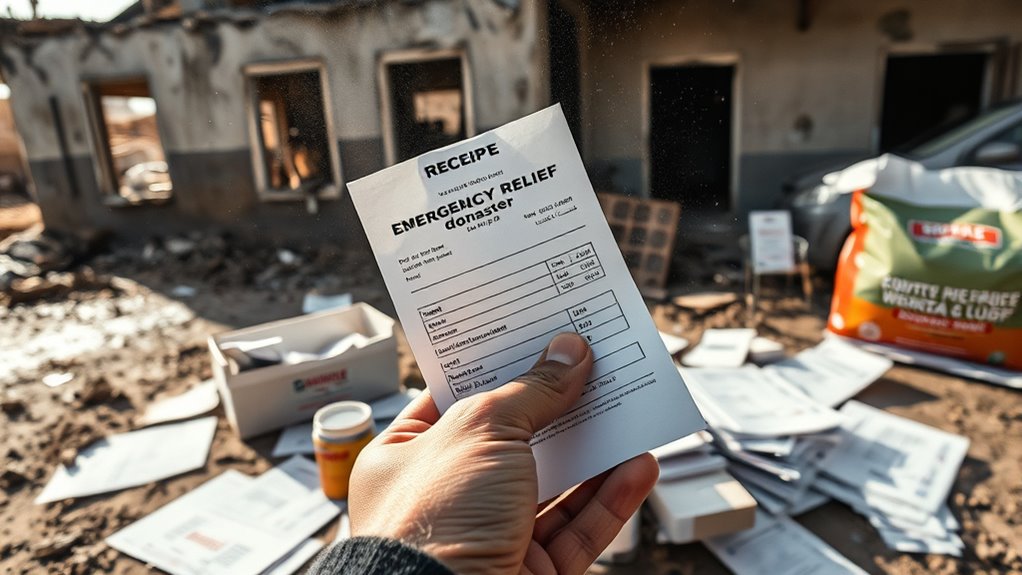
When disaster strikes, donating to relief efforts can provide both immediate help and tax benefits. If you’re considering making a donation, understanding how charitable deductions work can maximize your impact and savings. Charitable deductions allow you to reduce your taxable income by the amount you give to qualified organizations, which can make your contribution go even further. However, it’s important to be aware of tax deduction limits, as these can influence how much you can deduct in a given year.
Most taxpayers who itemize deductions can generally deduct donations to qualifying charities up to a certain percentage of their adjusted gross income (AGI). For example, cash donations to public charities are typically deductible up to 60% of your AGI, while donations of property or other assets might have different limits, such as 30% or 50%. When you surpass these limits, the excess amount can often be carried forward to future tax years—usually for up to five years—allowing you to claim additional deductions when your contributions are within the applicable limits.
To claim these charitable deductions, you need to keep proper records. For cash donations, a bank statement or canceled check may suffice, but for larger gifts, obtaining a written acknowledgment from the charity is recommended. For non-cash contributions, such as clothing or goods, you might need to provide a detailed list of items, and for larger property donations, an appraisal could be necessary to establish fair market value. Accurate documentation ensures you can substantiate your deduction if the IRS audits your return.
It’s also worth noting that recent tax law changes, such as those introduced during the COVID-19 pandemic, temporarily increased the standard deduction, which has made many taxpayers less likely to itemize. However, if you do itemize and donate after a disaster, claiming charitable deductions remains a valuable way to support relief efforts while reducing your tax burden. Remember, the key is to donate to qualified organizations recognized by the IRS. Not every charity qualifies, so verifying their status before donating is vital.
Additionally, understanding the effectiveness of eye patches can help you assess how certain health or beauty routines might complement your relief efforts by improving your well-being.
Finally, timing your donation can affect your tax benefits. Making a contribution before year-end allows you to claim the deduction in that tax year, which can be especially advantageous if you’re trying to offset a higher income or reduce your tax liability. By understanding charitable deductions and the associated tax deduction limits, you can support disaster relief efforts effectively while also optimizing your tax situation.
Frequently Asked Questions
Can I Claim a Deduction if I Donate Non-Cash Items?
Yes, you can claim a deduction for donating non-cash items if you follow proper donation valuation and appraisal requirements. You need to determine the fair market value of your items and obtain an appraisal if the donation exceeds the IRS threshold, usually $500. Keep detailed records, including receipts and appraisals, to support your claim. Accurate donation valuation guarantees you receive the correct tax benefit and adhere to IRS rules.
Are There Limits on How Much I Can Deduct?
Think of deduction limits as a safety net—you can usually deduct up to 60% of your adjusted gross income, but charitable caps vary depending on the type of donation and organization. Once you go beyond these limits, the excess can often be carried forward for up to five years. Always check specific rules to guarantee your generous contributions stay within the bounds of allowable deductions and avoid surprises.
How Do I Document Donations Made During a Disaster?
You should keep receipts and documentation for all donations made during a disaster. For cash gifts, bank statements or canceled checks work as proof. If you donate property worth over $5,000, you’ll need an appraisal to support your deduction. Always retain detailed records, including photographs or descriptions of donated items, to meet IRS documentation requirements and verify your deductions are valid.
What Are the Tax Implications for Donating to Foreign Charities?
Like a knight of yore, you seek to help abroad, but beware the tax maze. When you donate to foreign charities, your deductions depend on whether the charity is recognized under U.S. law. You might qualify for foreign tax credits to avoid double taxation, but rules vary by country. Always keep receipts and consult a tax pro to maximize your international donation benefits and guarantee compliance.
Can I Donate Anonymously and Still Claim a Deduction?
You can donate anonymously and still claim a deduction, but you’ll need to guarantee proper documentation. Anonymous donations can be made through a bank or check with no name attached, and the charity’s receipt will serve as proof of your deduction eligibility. Keep records of your donation, including the receipt, to substantiate your claim when filing taxes. Remember, the IRS requires accurate documentation for deducting charitable contributions.
Conclusion
Remember, when you give, you also receive in the form of potential tax benefits. By understanding the tax implications of your disaster donations, you can make more informed decisions and maximize your generosity. Keep in mind the saying, “A gift in time saves nine,” reminding you that your timely contribution can make a real difference. So, stay informed, donate wisely, and let your kindness shine brighter than any setback.