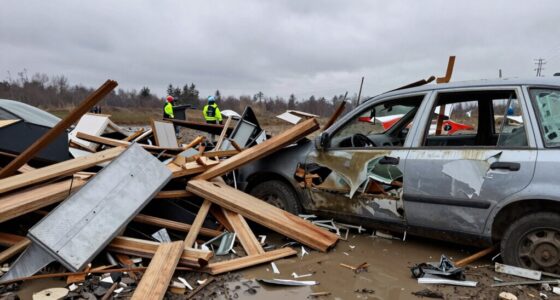
Updated rules now require you to carefully value your property losses using appropriate methods like cost basis or fair market value, especially after theft or disaster. You must also file insurance claims and keep detailed records, including photos and estimates, to substantiate your deductions. Remember, for personal-use property, losses generally only qualify if they exceed 10% of your adjusted gross income plus a $100 deduction. Exploring these details further will help you maximize your deductions accurately.

Get smart everyday buys delivered free with Prime
- Fast, free delivery on millions of items
- Prime Video, Amazon Music and more included
- Member-only deals all year
Key Takeaways
- Recent tax law updates limit casualty and theft loss deductions mainly to federally declared disasters for personal property.
- Proper valuation methods (cost basis, fair market value, replacement cost) are essential for accurate loss calculations.
- Losses must exceed 10% of adjusted gross income plus $100 to be deductible; minor losses are generally not claimed.
- Documentation such as photos, repair estimates, and insurance correspondence is vital for substantiating claims.
- Business property may follow different rules; always consider property type and usage when applying deduction rules.

Have you ever experienced a loss due to a theft or a sudden disaster? If so, you might be wondering how to handle the financial impact on your taxes. One way to offset some of that loss is through deductions for casualty and theft losses. These deductions can provide relief, but understanding the updated rules is essential to making the most of them. When you face such a loss, filing insurance claims is often your first step. If your insurance covers the damage or theft, you’ll need to determine the amount of your loss after the insurance payout. This is where valuation methods come into play—they help you calculate the actual loss you suffered. You’ll need to establish the property’s value before the incident and then subtract the amount recovered through insurance or other sources. Knowing the correct valuation method guarantees you accurately report your loss to the IRS, avoiding under- or over-stating it. Additionally, understanding how water damage affects property valuation can be crucial in certain loss scenarios. The IRS allows you to deduct the lesser of your actual loss or your adjusted basis in the property, but recent updates have refined how these calculations work. For personal-use property, you can only deduct losses that exceed 10% of your adjusted gross income, after accounting for a $100 per-incident deductible. This means that minor losses may not be deductible, so it’s important to keep detailed records. The valuation methods you choose—such as cost basis, fair market value, or replacement cost—can markedly influence your deduction amount. Using the appropriate method ensures your figures are accurate and compliant with current regulations. For example, if you own valuable jewelry, estimating its fair market value at the time of loss will give you a realistic figure for your deduction. Keep in mind, the rules around casualty and theft loss deductions have evolved, especially with recent tax law changes. The Tax Cuts and Jobs Act, for instance, limited these deductions primarily to losses related to federally declared disasters for personal property. However, for business property or certain other cases, different rules apply, and you may need to use specific valuation methods tailored to business assets. Regardless of your situation, thorough documentation is essential. Photograph the damaged property, keep repair estimates, and save insurance correspondence. These records support your insurance claims and ensure your valuation methods stand up if the IRS audits your return.
insurance claim documentation kit
As an affiliate, we earn on qualifying purchases.
As an affiliate, we earn on qualifying purchases.
Frequently Asked Questions
Can I Claim Casualty Losses for Damage Caused by Natural Disasters Outside My Property?
Yes, you can claim casualty losses for damage caused by natural disasters outside your property, like floods or wildfires. You’ll need to meet flood zone considerations and wildfire damage criteria, such as proving the damage was sudden and accidental. Keep records of the damage and insurance claims, and consider the timing of the event to verify it qualifies. This way, you can potentially deduct losses from qualifying natural disasters.
How Do I Determine the Fair Market Value of My Property Before and After a Loss?
To determine the fair market value before and after a loss, you should use appraisal methods like sales comparison, cost, or income approaches. Guarantee you consider valuation timing—ideally, get appraisals as close as possible to the date of the loss. This helps establish accurate values, making your casualty or theft loss deduction more precise. Keep detailed records of your appraisals for documentation and tax purposes.
Are There Specific Recordkeeping Requirements to Substantiate Casualty and Theft Loss Deductions?
You need to keep detailed records to substantiate your casualty and theft loss deductions. This includes documentation standards like photographs of the damage, police reports if applicable, and receipts or appraisals of the property’s value before and after the loss. Good recordkeeping requirements guarantee you can support your claim if questioned by the IRS. Maintain these records diligently, and organize them clearly for easy reference during tax time or an audit.
Can I Claim a Deduction if My Insurance Reimbursement Is Less Than the Loss Amount?
Did you know that nearly 60% of taxpayers miss out on potential deductions? If your insurance reimbursement is less than your total loss, you can still claim a deduction for the unreimbursed amount. Keep records of both the loss and your insurance payout to substantiate your claim. Remember, the difference between your loss and reimbursement is what you may deduct on your tax return.
Do Different Rules Apply for Personal Versus Business-Related Casualty and Theft Losses?
Yes, different rules apply for personal versus business-related casualty and theft losses. For personal property, you can generally deduct losses that exceed a certain threshold after insurance reimbursements and theft recovery. Business losses can be deducted more freely, often without the same thresholds. Keep in mind that theft recovery reduces your deductible loss, so if you recover part of the theft, it impacts your deduction amount.
Conclusion
Now that you know the updated rules for casualty and theft loss deductions, you’re practically a superhero armed with savvy tax knowledge! With these new rules, you can potentially save thousands and turn disaster into dollars. Don’t let unexpected losses drain your wallet—use these deductions to bounce back faster than you ever thought possible. Stay sharp, stay informed, and watch your tax savings soar like a rocket—because you’re now a casualty and theft loss deduction master!
Halloween Picks
halloween
As an affiliate, we earn on qualifying purchases.