TL;DR

Get smart everyday buys delivered free with Prime
- Fast, free delivery on millions of items
- Prime Video, Amazon Music and more included
- Member-only deals all year
For Thanksgiving leftovers, use shallow containers to cool food quickly, airtight leakproof containers for sauces and transport, and freezer-safe containers for food you will not eat within three to four days. Refrigerate perishable food within two hours, label each container with its storage date, and reheat leftovers to 165°F (74°C).
By the time the last slice of pie is gone, your refrigerator can look like a game of holiday Tetris: turkey under foil, gravy in a mug, and a casserole dish balanced on the cranberry sauce. The right containers turn that jumble into meals you can find, cool, and reheat safely.
This guide explains how to choose Thanksgiving food storage containers for different dishes, when to refrigerate or freeze leftovers, and how glass, plastic, and disposable pans fit into the plan. You’ll also get practical steps for labeling and sharing food, plus the key facts for keeping a busy holiday kitchen organized.
Thanksgiving often leaves households with more cooked food than they can eat in a few days. A little planning matters: containers help you cool portions, avoid leaks, track dates, and make a leftover lunch feel like a treat instead of a mystery box.
Refrigerate perishable leftovers within two hours, or within one hour above 90°F (32°C).
Use shallow containers for large portions so they cool faster, and do not wait for food to cool completely on the counter.
Eat refrigerated cooked leftovers within about three to four days; freeze portions you will not use in that window.
Check the container label before microwaving, freezing, or oven-heating it; aluminum pans do not belong in microwaves.
Label each container with its food name and storage date, and reheat leftovers to 165°F (74°C).
Choose a container that cools food quickly and fits the dish
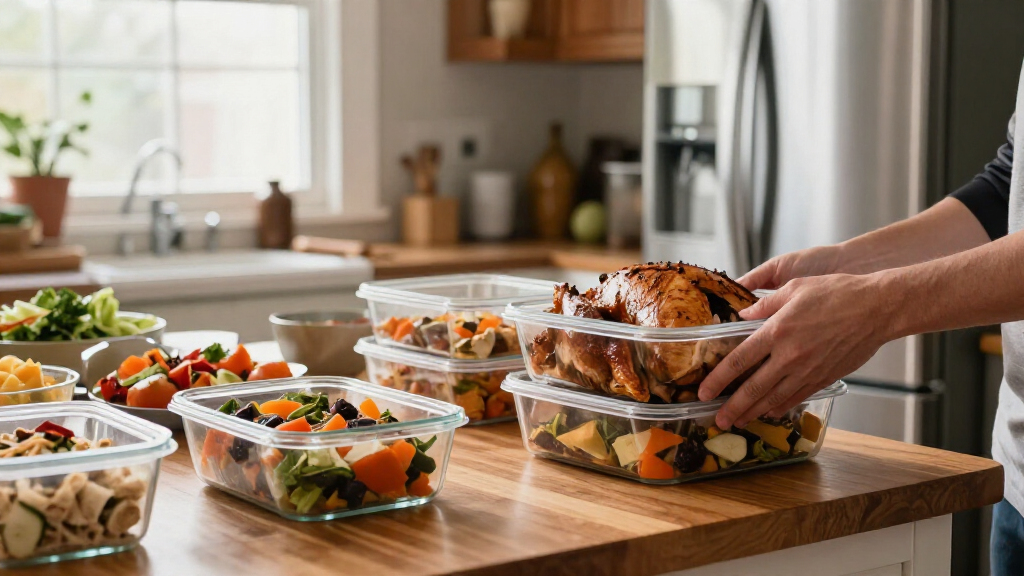
Thanksgiving food storage containers work best when their shape matches the food: shallow and wide for hot dishes, tight-sealing for liquids, and freezer-safe for portions you want to save. A deep container packed to the brim can trap heat in the middle, while a shallow one lets warmth escape more quickly.
Think of the container as a small landing pad for each dish. Put sliced turkey in a broad, shallow container rather than piling it into a tall jar. Use a snug, leakproof container for gravy, since a loose lid can leave a brown trail across the refrigerator shelf when someone nudges it.
For a real holiday table, separate the turkey, stuffing, and roasted vegetables rather than combining them into one oversized container. That makes it easier to reheat only what you want and to freeze portions independently. Leave a little room at the top for foods that expand as they freeze.
- Shallow, airtight containers: useful for cooked vegetables, turkey slices, and casseroles.
- Leakproof containers: best for gravy, cranberry sauce, and taking food to a relative.
- Freezer-safe containers or bags: useful for longer storage and reducing air around portions.
There is no magic container size for every household. A family with several guests may need larger dishes for a shared meal, while a smaller household may get more use from individual portions they can thaw one at a time.
Products Worth Considering

Dell 32 Plus 4K Monitor S3225QS, 31.5-Inch VA, 120Hz, FreeSync Premium

Brother INKvestment 6960 Wireless Color Inkjet All-in-One Printer with 11 x 17 Capabilities and 3.5 Color Touchscreen

Dell UltraSharp U4025QW 40 5K2K WUHD Curved LED Monitor (21:9)
As an affiliate, we earn on qualifying purchases.
Compare glass, plastic, and aluminum before you pack
Glass handles odors and stains well, plastic is light and less likely to break, and disposable aluminum can make sharing or freezing a casserole simple. The right choice depends on the food, the trip, and the manufacturer’s instructions for each container.
Glass is handy for turkey or stuffing you plan to reheat at home, provided the product label allows that use. It can go from refrigerator to microwave for some products, but sudden temperature changes can damage glass, and not every glass dish is oven-safe. Check the label before moving a cold dish into a hot oven.
Plastic is easier to carry to a neighbor’s house, especially when a child is helping clear the table. Look for containers marked microwave-safe or freezer-safe before reheating or freezing them. A lid that seals well for fridge storage might not be meant to go in the microwave.
| Material | Useful for | Check before use |
|---|---|---|
| Glass | Reusable storage and reheating when labeled for it | Microwave, oven, freezer, and temperature-change directions |
| Plastic | Lightweight portions and transport | Microwave and freezer labeling; lid instructions |
| Aluminum pan | Sharing or freezing casseroles | Never use in a microwave |
For example, you could send a neighbor home with stuffing in an aluminum pan and keep your own turkey slices in glass. That combination is convenient, but the pan must stay out of the microwave.
Refrigerate leftovers on time, then label every container
Put perishable Thanksgiving food in the refrigerator within two hours of cooking or serving, or within one hour if the temperature is above 90°F (32°C). Divide large amounts into shallow containers so the food cools more quickly; do not leave it on the counter until it feels completely cool.
That timing can get tricky when guests are still chatting and the kitchen is warm. Suppose dinner ends at 5 p.m. and a platter of turkey sits on the table until 7:30. The safe window has passed, so a storage container cannot undo the time at room temperature. If food has been left out too long, do not count on refrigeration or reheating to make it safe.
Once food is packed, write the food name and storage date on the lid or a removable label. “Turkey, Thursday” is more useful than “leftovers,” especially when a crowded refrigerator holds several nearly identical containers. Add reheating notes if you are sharing food with someone who may not know what is inside.
- Divide large dishes into shallow portions.
- Seal and refrigerate promptly within the time limit.
- Label each portion with the dish and date.
- Freeze portions you will not eat within three to four days.
This small routine saves time on Friday morning. Instead of opening three containers to find the cranberry sauce, you can read the label and reach for the right one.
Use the fridge for this week and the freezer for later
Most cooked Thanksgiving leftovers keep in the refrigerator for about three to four days; freeze food you do not expect to eat during that period. Frozen leftovers keep best quality for a few months, although food kept continuously frozen can remain safe longer. Quality and safety are different questions, so label dates and use older portions first.
A practical plan might be turkey sandwiches on Friday, a casserole portion on Saturday, and soup on Sunday. If you still have a container of turkey on Monday that you will not use, freeze it earlier rather than hoping you will get to it. A flat freezer bag of sliced turkey also stacks neatly beside a container of stuffing.
Freezer burn happens when food loses moisture at the surface, often because air reaches it. Use packaging made for freezing, press excess air out of freezer bags, and close lids securely. For gravy, leave room for expansion and choose a freezer-safe container; a tightly filled jar can crack as the liquid freezes.
Households with more guests may need a larger batch of containers, while a couple may prefer smaller servings that thaw quickly. Either way, portion before freezing. A single frozen block of mashed potatoes can be awkward to divide, while two smaller containers let you thaw just enough for dinner.
Storage dates matter: a sealed container makes food easier to store, but it does not keep leftovers safe indefinitely.
When you plan Thanksgiving food storage, consider what you will eat first and what deserves a spot in the freezer. That simple choice can reduce food waste and keep the back of the refrigerator from becoming a forgotten museum of holiday dishes.
Reheat leftovers evenly and take care when sharing
Reheat Thanksgiving leftovers to 165°F (74°C), checking the center with a food thermometer. Cover food to hold moisture and heat it more evenly; in a microwave, stir or rotate the food during reheating because the middle can stay cool while the edges steam.
For example, a thick scoop of mashed potatoes may feel hot on top but remain lukewarm underneath. Stir it halfway through, then check the center temperature. Add a small splash of milk or broth if the potatoes have dried out, and cover the dish loosely so steam can circulate.
You can reheat in the same container only if its label allows the method you plan to use. Remove lids that are not microwave-safe, and do not put aluminum pans in the microwave. When food is traveling to a guest’s home, pack it in a clean, leakproof container and share the storage date and reheating instructions.
If a relative is taking gravy and turkey, put the gravy in its own sealed container and keep it upright in a bag. That simple separation prevents a leak from soaking the turkey and gives the recipient a clear cue to refrigerate both items when they arrive. A removable label with the dish and date helps even more.
Container convenience matters, but the thermometer gives you a concrete check. A few seconds of stirring and a quick temperature reading are more reliable than guessing from steam or the warmth of the dish.
Set up a simple container station before guests arrive
A small container station can make cleanup calmer: gather clean containers, matching lids, labels, and a marker before the meal ends. That way, you can pack portions promptly instead of searching through a cabinet while food sits out.
Try sorting by task. Put shallow containers near the counter for turkey and vegetables, leakproof ones beside them for gravy, and freezer bags with a marker near the freezer. If you are hosting a large group, set aside a few smaller containers for guests who want to take a single meal home.
Uniform shapes can help a crowded refrigerator feel less like a leaning tower of dishes. Stack same-size containers in a stable column, keep labels facing outward, and leave room for air to circulate around stored food. Avoid overfilling; a lid that barely closes can leak, and a container packed to the rim gives you less room for expansion in the freezer.
When your cousin asks for a little turkey and stuffing, you can hand over a labeled portion instead of wrapping a plate in foil and hoping it survives the car ride. This is where reusable and disposable options each have a place: reusable containers work well for your own kitchen, while an inexpensive pan can be convenient when you do not expect it back.
Good organization does not require a matching set in every size. It requires enough clean containers for the foods you plan to keep, plus a way to tell what each one holds and when you stored it.
Frequently Asked Questions
How long can Thanksgiving leftovers stay in the refrigerator?
Most cooked leftovers keep for about three to four days in the refrigerator. Freeze portions you do not expect to eat within that period, and label them with the storage date.
How soon should I put Thanksgiving food away?
Refrigerate perishable food within two hours of cooking or serving, or within one hour if the temperature is above 90°F (32°C). Divide large amounts into shallow containers so they cool faster.
Should I let hot food cool completely before refrigerating it?
No. Do not leave perishable food out to cool completely. Divide large dishes into shallow portions and refrigerate them promptly within the safe time limit.
Are glass containers better than plastic for Thanksgiving leftovers?
Neither material is best for every job. Glass resists stains and odors, while plastic is light and less likely to break; check each product’s label for microwave, freezer, and oven use.
Can I put disposable aluminum pans in the microwave?
No. Keep aluminum pans out of the microwave. They can be convenient for sharing or freezing casseroles, but move food to a microwave-safe dish before reheating.
What temperature should reheated leftovers reach?
Reheat leftovers to 165°F (74°C) and check the center with a food thermometer. Cover food to retain moisture, and stir or rotate it during microwave heating.
Conclusion
Make your leftovers easy to trust: portion them into shallow containers, refrigerate them on time, and write the date where you can see it. Freeze what you will not eat within three to four days, and reheat each serving to 165°F (74°C).
Then the refrigerator becomes a neat row of tomorrow’s meals, not a stack of holiday mysteries.